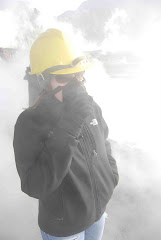
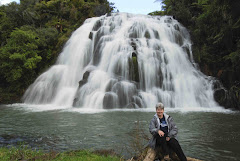
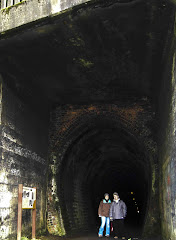
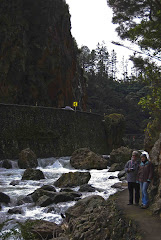
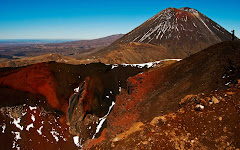
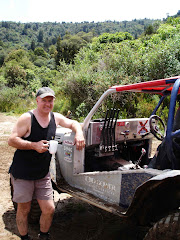
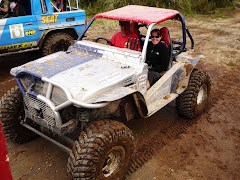
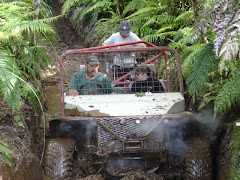
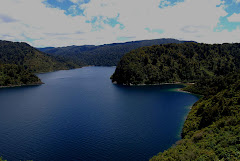
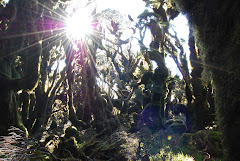
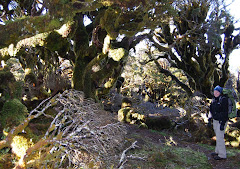
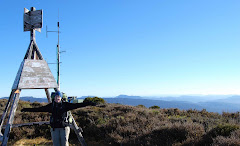
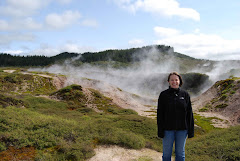
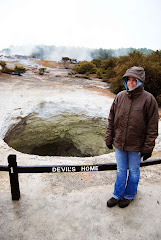
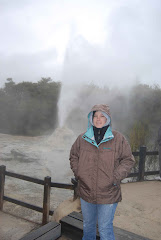
Easter Friday and Easter Monday are holidays here, and while Cory was on call on Friday, he did have Monday off. So we thought we’d better squeeze in a trip down to the Tongariro Mountain Range. We’d been hoping to do the Tongariro Crossing, which winds between Mt. Tongariro and Mt. Ngauruhoe, two dormant volcanoes.
Considered one of the best “day walks” in NZ, it takes from between 5 ½ to 8 hours. After a short climb, you are able to walk along the pass between the two volcanoes before descending on the other side. All literature about the walk warns readers that sturdy boots, adequate water, and appropriate clothing are necessary, as you are exposed with no cover for most of the walk. In the summer, the sun beats down, making it very hot; in the winter, the area is covered in snow. But the fall and the spring, especially on a gorgeous day like we had, offer beautiful views of pretty stunning scenery.
The Tongariro National Park was the first national park in New Zealand (and the fourth in the world); it was also the first national park to be gifted to a country from its indigenous people. The national park was formed before now-common ideas about conservation were established, which helps explain the oddity of having a town within the park. This town is suitably named National Park, and it is where Cory and I stayed. National Park is actually considered a village, and mostly consists of small lodges, hotels, cafes, and ski apparel stores. We had booked a package deal with one of the lodges; the package provided us with two nights’ accommodation, two breakfasts, food for the walk, dinner, transport to and from the track, and (murmured oh’s and ah’s…) a t-shirt.
Because of its length (long enough to offer a challenge, but short enough to be accessible to many), the Tongariro Crossing is very popular. This was definitely evidenced as we pulled into the car park on Sunday morning. The place was packed. Easter weekend and the start of school holidays (two weeks off between term one and term two) probably were popular choices for many, but I hadn’t prepared myself for just how busy it might be!
But we settled in to our walk. The first hour was fairly flat and easy-going. The second hour made up for any feelings of boredom by offering a steady climb up what is known as the Devil’s Staircase. The name does not suggest that the climb was easy, and I will not do so either. It was, however, well-maintained, with, quite literally, stairs for the steepest sections. It wasn’t really a pleasant walk, but it probably didn’t require the drama offered by a woman behind us as we climbed. She breathed heavily and really very loudly, sometimes letting out a short scream. At one point she ran past us, only to throw herself on the ground and sob. I couldn’t decide if it was funny or really bizarre; I’ve since decided it was both.
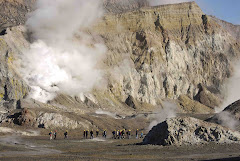
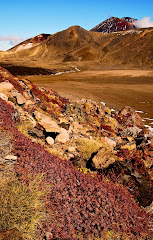
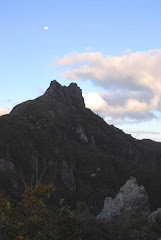
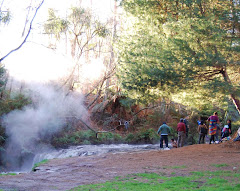
From the top of the staircase, though, we were able to forget the crazy lady. We had an excellent view of Mt. Ngauruhoe. It was an archetypal figure; looming above us, steep-sided, and richly red-colored. A small fumerole let off steam near the top. All in all, a very forbidding image. (So forbidding in fact, that it was used as Mount Doom in the Lord of the Rings movies.)
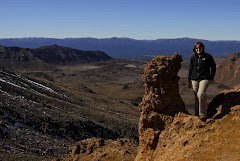
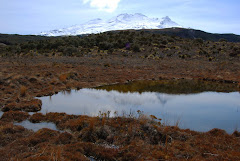
If Ngauruhoe offers the perfect mental image of a volcano, Tongariro is its opposite. It is the lowest of the three volcanoes in the range, and sprawls out across the northern end of the national park, with several old craters flanking the main crater. We walked over the barren surface of Tongariro’s Southern Crater and climbed up its sides.
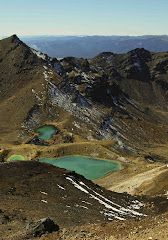
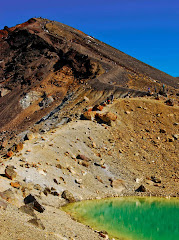
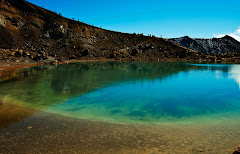
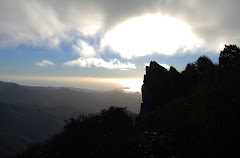
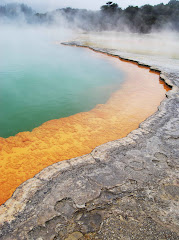
We then climbed a little further, scrambling up a rocky surface before choosing instead to walk in the snow, before reaching the Red Crater. Aptly named, the stunning colors result from the ferrous oxide expelled by the volcano. In the side of this crater, you could see a deep gash that seemed to tunnel deep into the volcano. From here, you could also look down on the several amazingly blue-green lakes, known at the Emerald Lakes. The color combinations were dramatic, and we decided to have lunch near the lakes. Up on the ridge, near the top of the Red Crater, it was very cold, with little protection from the wind. So we started our steep climb down, each step sliding several feet through loose rocks. After a few steps, you adjusted your movements so that you could use the slide to further your progress. It was very fun, sliding down with each step.
After lunch, we continued on our walk, passing through the Central Crater of Tongariro. It wasn’t until we had crossed it and climbed back out that we noticed the old lava flow. In the center of this large crater, you could see the black, cold lava that must have flowed from the current crater at some point. It was amazing.
The remainder of the walk slowly led you back down through the alpine tundra to the tree line. It was pleasant and easy-going. You could see why the walk was supposed to be the “best day walk” in NZ; our only grumble was that too many other people must have heard that claim, too. But you can’t always have it all, so we won’t complain!
Tuesday, April 14, 2009


Saturday, April 4, 2009
What a birthday! - March 28th
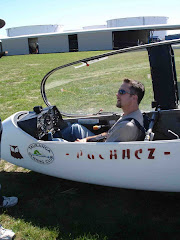
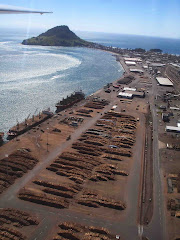
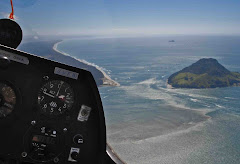
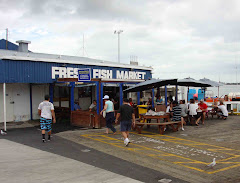
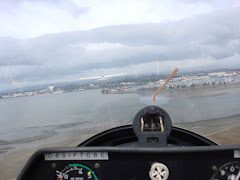
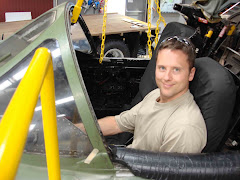
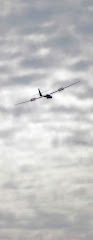
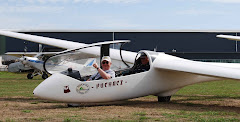
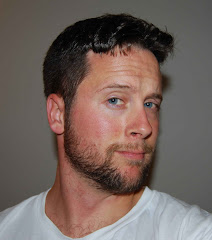
The sadness of turning 32 and counting the grey hairs in my newly-grown goatee was countered by a wonderfully planned weekend by my lovely wife. It started with lunch by the beach, followed by a full body message at the local hot pool spa. Then we were off to a local fossil, rock, and gem show (we really know how to party) and then back out to dinner at our favorite Italian place, Volare. Wine, bruschetta, risotto . . . perfecto! Sunday sleep-in was then followed by the world's best fish and chips at Fresh Bobby's (for those of you who have been there, you know what I am talking about). The grand finale was a glider flight gift from my family. After a short blurb on safety (basically which buttons and levers not to push), we were ready. It is amazing how nimble the glider is. Even on the ground if you move the stick left or right the glider will tilt back and forth. Shortly after getting going you are off the ground, well before the tow plane is. I was towed to 3000 ft, and we released the wire and were off. For 30 minutes we sailed over the city searching out thermals and then spiraling upward to sail down once again. At one point we were in the same thermal as another glider and were both spiraling upwards with no engine - pretty amazing! The view was magnificent and the few pictures I have added can't do it justice. It was an excellent birthday weekend. Thanks to all my friends and family for their warm birthday wishes!
Saturday, March 28, 2009
South Island trip: Installment II
The Milford Sounds area, while a major tourist attraction for New Zealand, is by no means an overpopulated area. There is one town, Te Anau, which has a population of 1785. A single road leads out of Te Anau and into the sounds. The Te Anau - Milford Highway is 120K long and takes you to the most inland point of Milford Sound. There, a small but attractive booking station offers a variety of cruises out on the sounds. Cory and I had mentioned when we were there with Mom and Dad that there was no souvenir shop and no food counter, even though these would surely rake in the cash. It is another major difference in how New Zealand chooses to manage its natural resources. But, as the teachers at school might say, I’ve lost the plot. Back to the point…
On our trip around the South Island with Mom and Dad we had cruised in the Milford Sound and really loved it. Cory and I knew that we would be back to walk the Milford Track. The Milford Track is a 33.5 mile walk in towards the sound. Because of its popularity, the Department of Conservation (DOC) handles booking requests and limits the number of trampers (aka, hikers) to 40. The DOC, as it does all over New Zealand, maintains a number of huts where trampers stay the night. The DOC hut system is a really fantastic system, with huts (some with fewer services) throughout both islands on well-known and much less well-known tracks. The huts on the Milford offered bunks with mattresses, cold running water, flush toilets, and gas cooking facilities. This all meant that we didn’t need to carry sleeping bag pads or the gas stove, leaving more space for the water filter, four days of food, cooking utensils, clothes, a few toiletries, first aid kits, etc. Each hut also boasted a small helicopter landing pad, which was used occasionally to drop supplies, but more often to offer emergency airlift services. Yikes.
Along with the 40 of us trampers who had booked through the DOC, a “guided tramping service” is also available. These folks pay good money, but the benefits are great. We often envied them when we ran into them on the track. They stay in private huts with flasher amenities (like a hot shower, or, really just any shower at all), have their meals prepared for them, and carry only the clothes they need for the walk in their pack. (This leaves them carrying something bigger than a regular back pack, but much, much smaller than the 17K or 38 lb. pack I had.)
During the summer’s busy season, trampers must walk a prescribed route with set distances each day. Our first day’s walk was very short – only 5k (3.1 miles). The second and third days were 16.5k (10 miles) and 14k (8.7 miles), respectively. The final day was to be 18k (11 miles). Since New Zealand has converted to metric, they use kilometers in their publications about the track, but the original track was cut and marked when miles were used; there are still markers at every mile.
We were scheduled to walk from Wednesday to Saturday. Tuesday night we checked into Keiko’s Bed and Breakfast. Keiko, a Kiwi who is originally from Japan, was not home, but Kevin, her husband and a former guide on the Milford was. We chatted, shared a glass of wine, and quizzed him about the track. Later we ate a meal in an Italian restaurant in Te Anau and went to bed early.
Wednesday morning, we woke up to gray skies and rain. Rain is sort of a given on the Milford Track, an area that averages between 6 and 9 meters a year. After a quick breakfast and many well-wishes from Kevin, we headed down to the Te Anau DOC office. Before you can start the track, you’ve got to get there, so we boarded a bus. The bus took us into to Te Anau Downs, a small settlement that offers a boating ramp and a lodge. Here we loaded onto a boat and cruised up the Clinton arm of Lake Te Anau. We got off the boat at Glade Wharf, where we would begin our day’s walk.
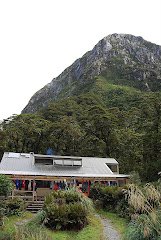
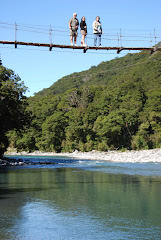
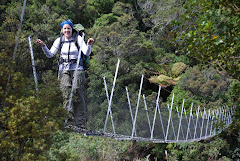
Everyone pulled on their rain gear, hoisted their packs on to their backs, and shoved off. Even with the rain coming down, the setting was gorgeous. We crossed the first of the nine suspension bridges on the track, wandered along the Clinton River, took a side trip to explore a bog area, and arrived at the first hut at about 2 in the afternoon. Each hut on the track was a little different, but all had 2 or more bunk rooms and a good-sized cooking facility. We hung up our rain gear, claimed two bunks, and got out some food for lunch. We ate a quick meal outside, but the sandflies (small black flies that leave terribly itchy bites) chased us back inside. After a dozen hands of rummy (the only card game we could remember the rules to) and a few chapters in our books, it was 5:00. The hut ranger was leading a little nature walk, so we bravely pulled on our rain gear and headed out with him.
I’m pretty unclear about what exactly a DOC ranger’s day-to-day life must be like, but I’d really like to know more. The Milford huts are only staffed during the summer, so the rangers must be assigned someplace else during the winter. During the summer, they live in a small, private hut near the other buildings. Each of the rangers we met were men and appeared to have no family with them. (I assume they couldn’t really have school-aged children on the track, because there was no way for a child to get to school. They’d have to walk out, hop on a boat, then catch a ride into Te Anau – a daily commute like this would take a minimum of 6 hours a day!) Our last ranger mentioned that that morning he’d been doing track maintenance a few kilometers up the track. We saw evidence of it that next morning after about 8 kilometers. Because the track doesn’t cater to vehicles of any kind, he must have spent the day walking to the worksite, completing the necessary tasks, and then walking home. But, even after the physical work and the long walking, his day wasn’t done. At night, rangers do a brief “hut talk”, informing trampers of what the next day’s route looks like, updating weather forecasts, and dealing with any inquiries. They also monitor the incoming trampers, so that when night falls, they have a head count for who has arrived. The ranger at our last hut, the most talkative of the three, told us some stories of not-so-bright trampers and the search attempts made on their behalf, another important role of the Milford Track rangers.
Our nature walk was excellent, though we were glad to once again pull off our rain gear and get ready for dinner. We entered into the warm cooking facility, where all most all of the 40 trampers had gathered. Most of us were walking with someone else, but there were a few people walking solo (2 women and 3 men) and a few walking in groups of four. All in all, there were seven young Americans, ten young Israelis, one young man from Holland, three young woman from places unknown, and about twenty 40-65 year olds from Australia and New Zealand. It was an interesting mix of youngish “foreigners” and older “locals”. But everyone was helpful, sharing food, advice, and in my case, band-aids.
Our first night we dined on gooey pasta and, for dessert, hot cocoa. After dinner, we struck up a conversation with two couples traveling together. One couple was from Guam and the other from Saipan. They were young Americans and had been traveling around NZ for several weeks. Three of them were dentists; the fourth was a dental hygienist. We talked dentistry and orthopaedics until the solar-powered lights shut off that night. It was clearly meant to be…
We woke up the next morning and headed off before the rain began. In fact, we got a good two hours in before the rain started. But, as you must cheerfully remind yourself when walking the Milford, more rain means more waterfalls. We walked through a steep-sided valley, with high-up waterfalls cascading down. In the winter, the area boasts 56 known avalanche paths, which is why we were doing this in summer. The rain began shortly before we sat down for lunch by a lake fed by a roaring waterfall. The day’s walk was a gentle uphill climb of 16.5k, and we were not quite half-way there.
Because of the rain, we had to stop and remind ourselves to take a look around. The hood on my rain gear pretty much takes care of any peripheral vision and I sort of need to concentrate on where I’m putting my feet, so I often found myself keeping a close eye on the track and missing out on the surroundings. But as we settled into a pace, it was easier to remember to appreciate the views.
We slogged into our hut that night, damp and worn out. Though it was not the longest day of the walk, the insipient uphill climb was tiring, and I’d managed to get large blisters on the back of both heels. Our feet were aching, too; others had the same complaint. During one of the hut talks, a ranger helpfully pointed out that on a scale of hardness from one to ten, with the hardness of diamonds scoring a ten, the rocks of this area were an eight. It did sort of explain the throbbing of our feet…
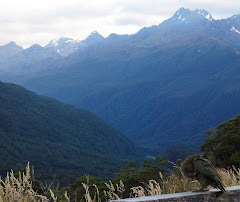
As we pulled off our gear on the porch of the hut, there were large signs saying that all gear needed to be hung up as there were “keas operating in the area”! You might remember these cheeky alpine parrots from an earlier posting. They are an attractive green and red parrot, and they love to explore. One rule at almost all DOC huts everywhere is that you remove tramping boots before entering; here though, we were told to bring our boots inside so that the keas wouldn’t dismantle them overnight. Their antics were a welcome spot of humor that night.
Trampers drifted in that night, hanging wet gear up near the wood-burning stove, changing into dry clothes, and swapping stories of the day’s walk. We sat down with our friends from Guam and Saipan and discussed the need for the DOC to offer massage services at each hut. (We figured the guided walkers probably all ready had that!) A few hands of rummy and a pleasant meal of noodles, canned chicken, and ibuprofen topped off the night. The next day was to be a shorter walk than day two, but we were crossing Mackinnon’s Pass, which meant a steep climb and a long downhill journey to our next hut.
A brochure provided by the DOC when you register to walk the Milford helpfully gives you a basic aerial view and a detailed verbal description of each day’s tramp. It also provides a cut away view of the track, demonstrating the change in altitude that the track covers. Frighteningly, most of that change in altitude seemed to occur all in day three’s walk. We would climb about 500 meters and drop about 950 meters. Because of the uphill and downhill, even though we covered only 14k, our walk was scheduled to take about seven hours (we’d covered 16k in six hours on day two).
The good news for me was that the uphill was only to take about two hours; I really hate uphill. The bad news for Cory was that the downhill was to take the next five hours; he really hates downhill. As we began our climb that morning, blisters freshly bandaged, stomachs full of oatmeal and apples, the sun was shining. It was a welcome change and would make the long day much better.
Our climb up was difficult, but not nearly as difficult as some other climbs we’ve done. (Remember Manuoha Hut in the Waikaremoana area – six hours of clambering uphill?) We ran into several guided walkers and I did envy their light load as they passed us. We also ran into one of their guides. We heard someone approaching very rapidly from behind. As we stepped off to the side, she marched passed us, saying cheerily “I hate uphills!” She was literally bounding from rock to rock, practically running. As a guide, she carried a full-sized pack on her back to, identical, in fact, to the one I was carrying. I was not bounding from rock to rock, however, and no one could claim that I was almost running. Clearly, she was in a league of her own. Having said this, the older trampers in our group were also keeping pace. Cory and I commented numerous times on how the 55-65 year olds were definitely hanging in there; they seemed especially to relish the more challenging parts of the track, like the day’s uphill climb.
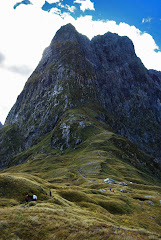
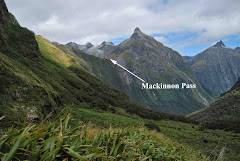
The switchbacks tightened as we neared the top of the pass. The views were wonderful and the sky had remained clear. Up on the pass, we stopped near the memorial cairn for old Mackinnon. He was the first guide on the Milford and was known to be a pretty stalwart character. Just beyond the cairn was the “twelve second drop”, where we peered over the edge cautiously. At 1073 meters, we could look over the area we’d walked through the previous day and could see where we were headed for that evening. Twelve seconds is the time it would take, supposedly, until you hit the bottom if you were to take a mistaken step off the cliff, unless of course, you found a ledge to bounce off first.
After a few photos, we walked along the ridge to the shelter on the top of the pass. The building had been blown away four times, but we were pretty sure that today wouldn’t be the fifth. We dropped our packs and celebrated the climb with a big bowl of hot miso soup. I also took the opportunity to check my blisters. As I peeled off my socks and pulled up my long underwear, my skin actually steamed in the cold air; it also stunk. The bandages had slid down and were now sort of just making new blisters. Luckily three Kiwi ladies descended on me with advice and more blister protection than one girl could need. I applied new bandages, and we prepared to set off.
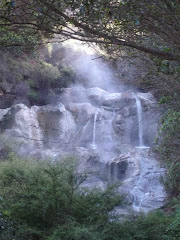
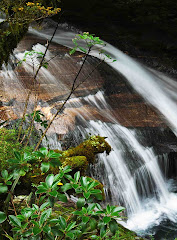
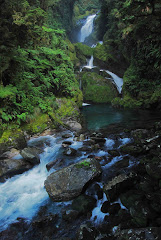
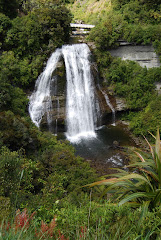
The downhill climb, while long, was very scenic. We began a series of switchbacks down the other side of the pass. Occasionally, we’d see a sign saying “Avalanche area – do not stop for 300 meters.” Eventually, there would be another sign indicating that it was safe to stop. People do walk the Milford track in winter; they are obviously crazy. Then, for almost an hour, we walked alongside a series of waterfalls. (Thank goodness for all that rain the past few days, huh?!) The pooling water was a stunning blue, and the falls cascaded down and down.
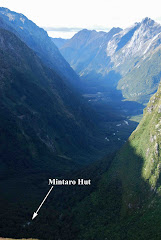
After we left the series of waterfalls, we set our sights upon Sutherland Falls. These three-tiered falls are the largest falls in New Zealand, and there was a short detour off the track to the falls; we’d been told not to miss them. It was at this point that I began to try and figure how much more we had to go. I spent a lot of time converting kilometers to miles, then figuring out my pace, and then converting back to kilometers. Often I’d forget a number that I’d converted and have to start again. Then I’d recheck my math a few times. Anything to quiet my annoying inner monologue!
Later, as we sat to have a break and a snack, our friends from Guam passed us. “Let us know with a whistle or something”, we said, “when you get to the 20 mile mark near the Sutherland Falls.” As we walked on, not ten minutes later, we heard a whistle, then a holler, then a cheer. They were probably the most glorious noises of the trip. Our strides lengthened, our pace increased. We were so pleased to drop our packs at the little shelter 45 minutes from the falls. We rubbed our shoulders and stretched out our backs. The little side walk without a pack would be a very welcome break.
We headed into Sutherland, running into more and more of our fellow trampers. Everyone looked exhausted, but knowing that we’d done the most difficult section seemed to elevate everyone’s spirits.
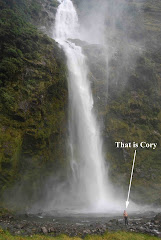
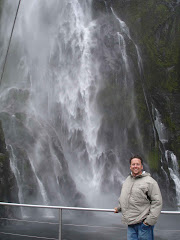
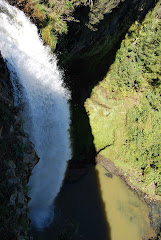
The falls themselves were wondrous. The top, 580 meters up, was barely discernible. Cory had decided he wanted to walk in behind the falls, so we once again shrugged into our rain gear. Water blew everywhere as we waded across the pool; we stumbled over rocks, the water and blowing spray making it hard to see. Finally, we stopped to look around. All I could see was water and spray on all sides; we were behind the falls, water crashing down around us.
As we made our way out, I pulled the hood of my rain gear down and massaged my scalp. I figured this was probably the closest to a shower I was going to get, and my hair was starting to style itself. We walked back to the shelter where we’d dropped our packs, had a snack, and continued on. The falls had been at mile 20, and the hut was at mile 22. These last two miles, though, took us right around an hour to walk. Cory’s knees were not feeling great and my blisters made a little complaint with each step.
That night we treated ourselves to a fancy dehydrated meal – tikka masala. It was good, but I wished we’d picked up the strawberry ice cream dehydrated dessert instead! Oh well! The next morning was to be an early one, as we needed to walk our longest distance yet, 18k, to meet the boat that was taking us out of the sound at 2 p.m. We definitely didn’t want to miss that boat!
After our last breakfast of oatmeal and apples the next morning, my blister-bandage fairy provided me with two more large bandages for my heels. Appropriately geared up, we headed off. Before long, we passed by the attractive Mackay Falls. A little Milford Track history for you…While Mackinnon cut the track from his namesake pass out to Lake Te Anau, Mackay and Sutherland cut the northeastern half of the trail, starting at the sound and working inland towards the pass. The story goes that when they stumbled on the first set of impressive falls, they flipped a coin to see who would name them. Mackay won, and the beautiful little Mackay falls got its European name. Sutherland was disappointed, but knew he would get to name the next falls they passed, thus he earned the right to give New Zealand’s largest falls his name. Maybe losing that toss wasn’t so bad after all.
We carried on, acutely aware of the time. It was another sunny day, and I’d even been so daring as to put my rain coat and pack cover in my pack. I knew better than to tempt the Fates, so I did wear my rain pants. (Should it start to rain, it is way too much work to take off gaiters and boots to put on rain pants before putting gaiters and boots back on. At that point, you may as well just get wet.) Since many of us were on the 2:00 p.m. boat, most of us had taken off about the same time. We exchanged pleasantries as we passed, and a large group of us settled at a small shelter for lunch together. Here we met up with our friends from Guam and Saipan and did the last three and a half miles together.
By this point, I was watching out for mile markers like a nervous drug dealer might scan for police. I wanted it to be over. Luckily, the company was a good distraction and the 2:00 deadline was a good motivator. Then, suddenly, with a cry from the front of the pack, we were there. At a small shelter, a few of our fellow walkers were sprawled out. Without a moment’s hesitation, I peeled off gaiters, boots, socks, and rain pants. The sandflies, too, without a moment’s hesitation, located us. So after painting on more bug spray, we took a gander around us. A small path led from the shelter to a wharf. A sign indicated that we had completed the Milford Track, all 33.5 miles of it.
I do realize that 33.5 miles doesn’t really sound all that impressive. In fact, by the third day, as we were at our most tired, we hadn’t even done the equivalent of a marathon yet. Feeling acutely weak, we tried listing the challenges we faced: the elevation changes were significant, the pack on our back was heavy, the terrain underfoot was uneven at best. Then we remembered all the ultra marathoners and the runners that crossed mountains and more… We decided the people that do those are just crazy and had to leave it at that.
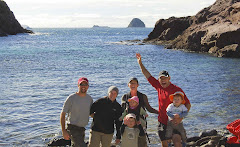
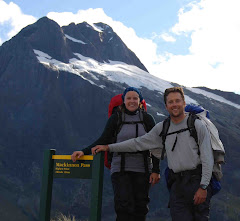
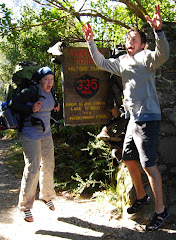
So we celebrated our 33.5 anyway. The sign was a reward in itself. It boldly proclaimed the miles and was hung about with worn out tramping boots. Some were barely in one piece, with soles that were taped together, and some looked perfectly fine, as though their owners had simply hung up their boots both literally and figuratively. Someone had the bright idea to take a picture with the sign in the background as we jumped to show our delight. I wasn’t sure I’d be able to jump; I imagine my calf muscles cramping up so significantly that I would crash to the ground upon landing. But we did the requisite “jumping with delight” picture, and I even managed to get off the ground.
It wasn’t a long wait for the boat to arrive, but we were faced with the unappealing news that we had just a little further to walk. The water was low and the boat had to dock at a point some 400 meters further along. Most of us had replaced our boots with sandals, and being too lazy to even strap on my pack properly, we wobbled across a few more steps of rocky terrain. Many made jokes about this last little distance - surely, the guided walkers would not have had to walk clear out here!
We crammed onto the boat, loading up dirty packs, stinking boots, and exhausted trampers. Almost everyone sat outside, enjoying the short ride through Milford Sound. We unloaded, said our goodbyes to our new friends, and boarded a bus back to Te Anau.
We dined that night in the same Italian restaurant that we’d eaten in earlier. Both of us finished every bite of our meal and did so quickly. Cory, who usually helps moderate my excessive eating, let me get my own dessert, but I couldn’t even finish it – it was the richest, sweetest thing I’d had in so many days.
We slept well that night, needless to say, and awoke to catch our plane the next morning. We exchanged stories with Kevin, our host, over breakfast, then limped to our car to drive to the airport.
We laughed at ourselves all day, as any change from sitting to standing took some time, and walking was more like shuffling. We sat in the $2 massage chairs at the airport and enjoyed all four minutes of it.
As we deplaned in Tauranga, the heat rose off the asphalt to greet us. It was good to be home.
On our trip around the South Island with Mom and Dad we had cruised in the Milford Sound and really loved it. Cory and I knew that we would be back to walk the Milford Track. The Milford Track is a 33.5 mile walk in towards the sound. Because of its popularity, the Department of Conservation (DOC) handles booking requests and limits the number of trampers (aka, hikers) to 40. The DOC, as it does all over New Zealand, maintains a number of huts where trampers stay the night. The DOC hut system is a really fantastic system, with huts (some with fewer services) throughout both islands on well-known and much less well-known tracks. The huts on the Milford offered bunks with mattresses, cold running water, flush toilets, and gas cooking facilities. This all meant that we didn’t need to carry sleeping bag pads or the gas stove, leaving more space for the water filter, four days of food, cooking utensils, clothes, a few toiletries, first aid kits, etc. Each hut also boasted a small helicopter landing pad, which was used occasionally to drop supplies, but more often to offer emergency airlift services. Yikes.
Along with the 40 of us trampers who had booked through the DOC, a “guided tramping service” is also available. These folks pay good money, but the benefits are great. We often envied them when we ran into them on the track. They stay in private huts with flasher amenities (like a hot shower, or, really just any shower at all), have their meals prepared for them, and carry only the clothes they need for the walk in their pack. (This leaves them carrying something bigger than a regular back pack, but much, much smaller than the 17K or 38 lb. pack I had.)
During the summer’s busy season, trampers must walk a prescribed route with set distances each day. Our first day’s walk was very short – only 5k (3.1 miles). The second and third days were 16.5k (10 miles) and 14k (8.7 miles), respectively. The final day was to be 18k (11 miles). Since New Zealand has converted to metric, they use kilometers in their publications about the track, but the original track was cut and marked when miles were used; there are still markers at every mile.
We were scheduled to walk from Wednesday to Saturday. Tuesday night we checked into Keiko’s Bed and Breakfast. Keiko, a Kiwi who is originally from Japan, was not home, but Kevin, her husband and a former guide on the Milford was. We chatted, shared a glass of wine, and quizzed him about the track. Later we ate a meal in an Italian restaurant in Te Anau and went to bed early.
Wednesday morning, we woke up to gray skies and rain. Rain is sort of a given on the Milford Track, an area that averages between 6 and 9 meters a year. After a quick breakfast and many well-wishes from Kevin, we headed down to the Te Anau DOC office. Before you can start the track, you’ve got to get there, so we boarded a bus. The bus took us into to Te Anau Downs, a small settlement that offers a boating ramp and a lodge. Here we loaded onto a boat and cruised up the Clinton arm of Lake Te Anau. We got off the boat at Glade Wharf, where we would begin our day’s walk.
Everyone pulled on their rain gear, hoisted their packs on to their backs, and shoved off. Even with the rain coming down, the setting was gorgeous. We crossed the first of the nine suspension bridges on the track, wandered along the Clinton River, took a side trip to explore a bog area, and arrived at the first hut at about 2 in the afternoon. Each hut on the track was a little different, but all had 2 or more bunk rooms and a good-sized cooking facility. We hung up our rain gear, claimed two bunks, and got out some food for lunch. We ate a quick meal outside, but the sandflies (small black flies that leave terribly itchy bites) chased us back inside. After a dozen hands of rummy (the only card game we could remember the rules to) and a few chapters in our books, it was 5:00. The hut ranger was leading a little nature walk, so we bravely pulled on our rain gear and headed out with him.
I’m pretty unclear about what exactly a DOC ranger’s day-to-day life must be like, but I’d really like to know more. The Milford huts are only staffed during the summer, so the rangers must be assigned someplace else during the winter. During the summer, they live in a small, private hut near the other buildings. Each of the rangers we met were men and appeared to have no family with them. (I assume they couldn’t really have school-aged children on the track, because there was no way for a child to get to school. They’d have to walk out, hop on a boat, then catch a ride into Te Anau – a daily commute like this would take a minimum of 6 hours a day!) Our last ranger mentioned that that morning he’d been doing track maintenance a few kilometers up the track. We saw evidence of it that next morning after about 8 kilometers. Because the track doesn’t cater to vehicles of any kind, he must have spent the day walking to the worksite, completing the necessary tasks, and then walking home. But, even after the physical work and the long walking, his day wasn’t done. At night, rangers do a brief “hut talk”, informing trampers of what the next day’s route looks like, updating weather forecasts, and dealing with any inquiries. They also monitor the incoming trampers, so that when night falls, they have a head count for who has arrived. The ranger at our last hut, the most talkative of the three, told us some stories of not-so-bright trampers and the search attempts made on their behalf, another important role of the Milford Track rangers.
Our nature walk was excellent, though we were glad to once again pull off our rain gear and get ready for dinner. We entered into the warm cooking facility, where all most all of the 40 trampers had gathered. Most of us were walking with someone else, but there were a few people walking solo (2 women and 3 men) and a few walking in groups of four. All in all, there were seven young Americans, ten young Israelis, one young man from Holland, three young woman from places unknown, and about twenty 40-65 year olds from Australia and New Zealand. It was an interesting mix of youngish “foreigners” and older “locals”. But everyone was helpful, sharing food, advice, and in my case, band-aids.
Our first night we dined on gooey pasta and, for dessert, hot cocoa. After dinner, we struck up a conversation with two couples traveling together. One couple was from Guam and the other from Saipan. They were young Americans and had been traveling around NZ for several weeks. Three of them were dentists; the fourth was a dental hygienist. We talked dentistry and orthopaedics until the solar-powered lights shut off that night. It was clearly meant to be…
We woke up the next morning and headed off before the rain began. In fact, we got a good two hours in before the rain started. But, as you must cheerfully remind yourself when walking the Milford, more rain means more waterfalls. We walked through a steep-sided valley, with high-up waterfalls cascading down. In the winter, the area boasts 56 known avalanche paths, which is why we were doing this in summer. The rain began shortly before we sat down for lunch by a lake fed by a roaring waterfall. The day’s walk was a gentle uphill climb of 16.5k, and we were not quite half-way there.
Because of the rain, we had to stop and remind ourselves to take a look around. The hood on my rain gear pretty much takes care of any peripheral vision and I sort of need to concentrate on where I’m putting my feet, so I often found myself keeping a close eye on the track and missing out on the surroundings. But as we settled into a pace, it was easier to remember to appreciate the views.
We slogged into our hut that night, damp and worn out. Though it was not the longest day of the walk, the insipient uphill climb was tiring, and I’d managed to get large blisters on the back of both heels. Our feet were aching, too; others had the same complaint. During one of the hut talks, a ranger helpfully pointed out that on a scale of hardness from one to ten, with the hardness of diamonds scoring a ten, the rocks of this area were an eight. It did sort of explain the throbbing of our feet…
As we pulled off our gear on the porch of the hut, there were large signs saying that all gear needed to be hung up as there were “keas operating in the area”! You might remember these cheeky alpine parrots from an earlier posting. They are an attractive green and red parrot, and they love to explore. One rule at almost all DOC huts everywhere is that you remove tramping boots before entering; here though, we were told to bring our boots inside so that the keas wouldn’t dismantle them overnight. Their antics were a welcome spot of humor that night.
Trampers drifted in that night, hanging wet gear up near the wood-burning stove, changing into dry clothes, and swapping stories of the day’s walk. We sat down with our friends from Guam and Saipan and discussed the need for the DOC to offer massage services at each hut. (We figured the guided walkers probably all ready had that!) A few hands of rummy and a pleasant meal of noodles, canned chicken, and ibuprofen topped off the night. The next day was to be a shorter walk than day two, but we were crossing Mackinnon’s Pass, which meant a steep climb and a long downhill journey to our next hut.
A brochure provided by the DOC when you register to walk the Milford helpfully gives you a basic aerial view and a detailed verbal description of each day’s tramp. It also provides a cut away view of the track, demonstrating the change in altitude that the track covers. Frighteningly, most of that change in altitude seemed to occur all in day three’s walk. We would climb about 500 meters and drop about 950 meters. Because of the uphill and downhill, even though we covered only 14k, our walk was scheduled to take about seven hours (we’d covered 16k in six hours on day two).
The good news for me was that the uphill was only to take about two hours; I really hate uphill. The bad news for Cory was that the downhill was to take the next five hours; he really hates downhill. As we began our climb that morning, blisters freshly bandaged, stomachs full of oatmeal and apples, the sun was shining. It was a welcome change and would make the long day much better.
Our climb up was difficult, but not nearly as difficult as some other climbs we’ve done. (Remember Manuoha Hut in the Waikaremoana area – six hours of clambering uphill?) We ran into several guided walkers and I did envy their light load as they passed us. We also ran into one of their guides. We heard someone approaching very rapidly from behind. As we stepped off to the side, she marched passed us, saying cheerily “I hate uphills!” She was literally bounding from rock to rock, practically running. As a guide, she carried a full-sized pack on her back to, identical, in fact, to the one I was carrying. I was not bounding from rock to rock, however, and no one could claim that I was almost running. Clearly, she was in a league of her own. Having said this, the older trampers in our group were also keeping pace. Cory and I commented numerous times on how the 55-65 year olds were definitely hanging in there; they seemed especially to relish the more challenging parts of the track, like the day’s uphill climb.
The switchbacks tightened as we neared the top of the pass. The views were wonderful and the sky had remained clear. Up on the pass, we stopped near the memorial cairn for old Mackinnon. He was the first guide on the Milford and was known to be a pretty stalwart character. Just beyond the cairn was the “twelve second drop”, where we peered over the edge cautiously. At 1073 meters, we could look over the area we’d walked through the previous day and could see where we were headed for that evening. Twelve seconds is the time it would take, supposedly, until you hit the bottom if you were to take a mistaken step off the cliff, unless of course, you found a ledge to bounce off first.
After a few photos, we walked along the ridge to the shelter on the top of the pass. The building had been blown away four times, but we were pretty sure that today wouldn’t be the fifth. We dropped our packs and celebrated the climb with a big bowl of hot miso soup. I also took the opportunity to check my blisters. As I peeled off my socks and pulled up my long underwear, my skin actually steamed in the cold air; it also stunk. The bandages had slid down and were now sort of just making new blisters. Luckily three Kiwi ladies descended on me with advice and more blister protection than one girl could need. I applied new bandages, and we prepared to set off.
The downhill climb, while long, was very scenic. We began a series of switchbacks down the other side of the pass. Occasionally, we’d see a sign saying “Avalanche area – do not stop for 300 meters.” Eventually, there would be another sign indicating that it was safe to stop. People do walk the Milford track in winter; they are obviously crazy. Then, for almost an hour, we walked alongside a series of waterfalls. (Thank goodness for all that rain the past few days, huh?!) The pooling water was a stunning blue, and the falls cascaded down and down.
After we left the series of waterfalls, we set our sights upon Sutherland Falls. These three-tiered falls are the largest falls in New Zealand, and there was a short detour off the track to the falls; we’d been told not to miss them. It was at this point that I began to try and figure how much more we had to go. I spent a lot of time converting kilometers to miles, then figuring out my pace, and then converting back to kilometers. Often I’d forget a number that I’d converted and have to start again. Then I’d recheck my math a few times. Anything to quiet my annoying inner monologue!
Later, as we sat to have a break and a snack, our friends from Guam passed us. “Let us know with a whistle or something”, we said, “when you get to the 20 mile mark near the Sutherland Falls.” As we walked on, not ten minutes later, we heard a whistle, then a holler, then a cheer. They were probably the most glorious noises of the trip. Our strides lengthened, our pace increased. We were so pleased to drop our packs at the little shelter 45 minutes from the falls. We rubbed our shoulders and stretched out our backs. The little side walk without a pack would be a very welcome break.
We headed into Sutherland, running into more and more of our fellow trampers. Everyone looked exhausted, but knowing that we’d done the most difficult section seemed to elevate everyone’s spirits.
The falls themselves were wondrous. The top, 580 meters up, was barely discernible. Cory had decided he wanted to walk in behind the falls, so we once again shrugged into our rain gear. Water blew everywhere as we waded across the pool; we stumbled over rocks, the water and blowing spray making it hard to see. Finally, we stopped to look around. All I could see was water and spray on all sides; we were behind the falls, water crashing down around us.
As we made our way out, I pulled the hood of my rain gear down and massaged my scalp. I figured this was probably the closest to a shower I was going to get, and my hair was starting to style itself. We walked back to the shelter where we’d dropped our packs, had a snack, and continued on. The falls had been at mile 20, and the hut was at mile 22. These last two miles, though, took us right around an hour to walk. Cory’s knees were not feeling great and my blisters made a little complaint with each step.
That night we treated ourselves to a fancy dehydrated meal – tikka masala. It was good, but I wished we’d picked up the strawberry ice cream dehydrated dessert instead! Oh well! The next morning was to be an early one, as we needed to walk our longest distance yet, 18k, to meet the boat that was taking us out of the sound at 2 p.m. We definitely didn’t want to miss that boat!
After our last breakfast of oatmeal and apples the next morning, my blister-bandage fairy provided me with two more large bandages for my heels. Appropriately geared up, we headed off. Before long, we passed by the attractive Mackay Falls. A little Milford Track history for you…While Mackinnon cut the track from his namesake pass out to Lake Te Anau, Mackay and Sutherland cut the northeastern half of the trail, starting at the sound and working inland towards the pass. The story goes that when they stumbled on the first set of impressive falls, they flipped a coin to see who would name them. Mackay won, and the beautiful little Mackay falls got its European name. Sutherland was disappointed, but knew he would get to name the next falls they passed, thus he earned the right to give New Zealand’s largest falls his name. Maybe losing that toss wasn’t so bad after all.
We carried on, acutely aware of the time. It was another sunny day, and I’d even been so daring as to put my rain coat and pack cover in my pack. I knew better than to tempt the Fates, so I did wear my rain pants. (Should it start to rain, it is way too much work to take off gaiters and boots to put on rain pants before putting gaiters and boots back on. At that point, you may as well just get wet.) Since many of us were on the 2:00 p.m. boat, most of us had taken off about the same time. We exchanged pleasantries as we passed, and a large group of us settled at a small shelter for lunch together. Here we met up with our friends from Guam and Saipan and did the last three and a half miles together.
By this point, I was watching out for mile markers like a nervous drug dealer might scan for police. I wanted it to be over. Luckily, the company was a good distraction and the 2:00 deadline was a good motivator. Then, suddenly, with a cry from the front of the pack, we were there. At a small shelter, a few of our fellow walkers were sprawled out. Without a moment’s hesitation, I peeled off gaiters, boots, socks, and rain pants. The sandflies, too, without a moment’s hesitation, located us. So after painting on more bug spray, we took a gander around us. A small path led from the shelter to a wharf. A sign indicated that we had completed the Milford Track, all 33.5 miles of it.
I do realize that 33.5 miles doesn’t really sound all that impressive. In fact, by the third day, as we were at our most tired, we hadn’t even done the equivalent of a marathon yet. Feeling acutely weak, we tried listing the challenges we faced: the elevation changes were significant, the pack on our back was heavy, the terrain underfoot was uneven at best. Then we remembered all the ultra marathoners and the runners that crossed mountains and more… We decided the people that do those are just crazy and had to leave it at that.
So we celebrated our 33.5 anyway. The sign was a reward in itself. It boldly proclaimed the miles and was hung about with worn out tramping boots. Some were barely in one piece, with soles that were taped together, and some looked perfectly fine, as though their owners had simply hung up their boots both literally and figuratively. Someone had the bright idea to take a picture with the sign in the background as we jumped to show our delight. I wasn’t sure I’d be able to jump; I imagine my calf muscles cramping up so significantly that I would crash to the ground upon landing. But we did the requisite “jumping with delight” picture, and I even managed to get off the ground.
It wasn’t a long wait for the boat to arrive, but we were faced with the unappealing news that we had just a little further to walk. The water was low and the boat had to dock at a point some 400 meters further along. Most of us had replaced our boots with sandals, and being too lazy to even strap on my pack properly, we wobbled across a few more steps of rocky terrain. Many made jokes about this last little distance - surely, the guided walkers would not have had to walk clear out here!
We crammed onto the boat, loading up dirty packs, stinking boots, and exhausted trampers. Almost everyone sat outside, enjoying the short ride through Milford Sound. We unloaded, said our goodbyes to our new friends, and boarded a bus back to Te Anau.
We dined that night in the same Italian restaurant that we’d eaten in earlier. Both of us finished every bite of our meal and did so quickly. Cory, who usually helps moderate my excessive eating, let me get my own dessert, but I couldn’t even finish it – it was the richest, sweetest thing I’d had in so many days.
We slept well that night, needless to say, and awoke to catch our plane the next morning. We exchanged stories with Kevin, our host, over breakfast, then limped to our car to drive to the airport.
We laughed at ourselves all day, as any change from sitting to standing took some time, and walking was more like shuffling. We sat in the $2 massage chairs at the airport and enjoyed all four minutes of it.
As we deplaned in Tauranga, the heat rose off the asphalt to greet us. It was good to be home.
Wednesday, March 25, 2009
South Island trip: Installment I
After almost two weeks back at work, Cory and I decided it was probably time for a vacation. We’d been hoping to get back down to the South Island one more time, so we took the opportunity to hop on a plane for Queenstown.
We picked up a rental car and drove off to Twizel. Twizel is in the Mackenzie Basin, a beautiful area sandwich between the coast and the Southern Alps. Our first stop was at a kaki preservation area. The kaki is a black stilt, a rare New Zealand bird. Between loss of habitat and the introduction of predators, their numbers have been decreasing steadily for years. We were able to see some in the protected aviaries, but did not see any in the wild.
Hoping to get luckier with our next “spotting”, we headed on to Lake Tekapo. Mount John is the home to the largest observatory in New Zealand. That night, we dressed in our warm clothes and headed up to the observatory. We met up with guides who took us to a few different telescopes to stargaze.
Cory and I had just finished a great NZ-oriented astronomy book, and we were able to pick out the Southern Cross to orient ourselves due south. The constellation Orion stands on his head in this hemisphere, but conveniently still wears his identifiable belt. Cory found Betelgeuse (you know, like “beetle juice” – surely it spawned the movie), but I was left to the kindness of our guide. In addition to pointing out several other features that could be viewed by the naked eye, he set up a portable telescope for us. Even better, though, was when he took us into one of the domes and we looked through a larger telescope. We saw star systems, nebulas, and Saturn with four of its moons.
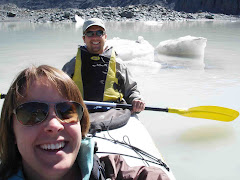
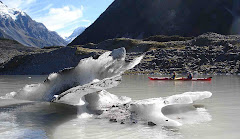
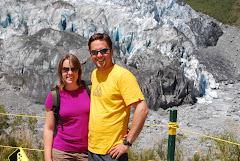
There was no time to catch up on our sleep, though, as the next morning we headed towards Mount Cook. There are several glaciers in this area, and we were going kayaking in the lake that has formed at the terminal face of one such glacier. After a short hike, we loaded into our kayak and shot off into the lake. The water was unbelievably cold; large icebergs, which had fallen from the face of the glacier floated in the water. We paddled around, exploring the ice chunks, and then made our way towards the face of the glacier. Our guide instructed us that, if a significant icefall should occur, that we were to face our kayaks directly perpendicular to the glacier, so that we could ride out any wave that might occur. I didn’t really relish the thought of taking a dip in the icy water, so we stayed perpendicular as we gazed at the terminal face. Occasionally, rocks would fall from the top of the face with a low, loud grumbling and splashing.
After having lunch and warming up, we headed down to the lakeside town of Wanaka. Walking a long the shore that afternoon, someone called out to Cory. He was wearing a University of Iowa shirt; the woman’s husband had been to UI. It is strange to hear an American accent – at first I don’t even notice that it is unusual, and then, once I do, sometimes I can’t pinpoint what is different until later. I know I will miss the Kiwi accent when we return.
That night, in Wanaka, we went to the Cinema Paradiso. It is a small movie theater, playing blockbusters, indy films, and foreign flicks. The theater itself has no typical move theater seats, but instead offers a selection of couches, recliners, and even a converted car. Even more pleasing than the seating options were the food options. You can order dinner in advance and have it served at intermission! Cory went with a pizza, while I had veggie lasagna. When intermission was over, I hadn’t yet finished my garlic bread, so I took that and my glass of wine back into the theater with me. Fantastic! I’m convinced a similar type of theater would be a huge hit in Iowa City and will patiently wait for someone to open one. Please have it ready by the time we get back…
The next day was our leisurely day and we spent it wandering around Arrowtown. Arrowtown was once the site of a large gold panning operation, and has now become a touristy village. But it was a gorgeous day, and we enjoyed wandering around the shops and galleries. We had a wonderful meal that night at an excellent restaurant, Saffron. The head chef caught me with my eyes closed and sighing while eating the whitebait soufflé. After turning a bright shade of red, I decided that he probably didn’t mind someone enjoying the food he’d created, even if it was a little over the top.
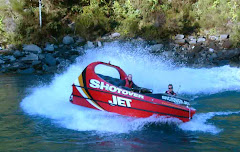
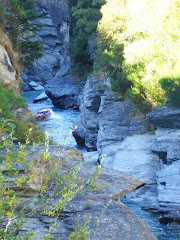
We were well rested and well fed before we wound back to Queenstown the next morning. Queenstown bills itself as the adrenaline capital of New Zealand and the home of the first bungy jump. You’ll be disappointed to learn we opted out of all but the least dangerous. We headed straight for the Shotover River and the jetboating offered there. Jetboating is sort of like riding a rollercoaster on a river, without that slow “up” part. After gearing up with warm clothes, large waterproof parkas, and life jackets, we loaded into the three ton boat. Our driver, who probably had his script written by an underpaid comedian, asked if this was everyone’s first time in a jetboat before letting us know that it was his first time, too! Then we grabbed on to the handholds and took off. The jetboat flew down the narrow river gorge, occasionally making 360 degree spins, before careening back towards the rocky cliffs. We sat behind a mother and her two grown daughters; all three screamed at every opportunity, giving the ride a delightful amusement park feel.
That was all the excitement we could handle for one day, so we wisely drove down to Te Anau to prepare for our next big adventure. The next morning we were to leave to walk the Milford Track, a four-day hike through the sounds.
We picked up a rental car and drove off to Twizel. Twizel is in the Mackenzie Basin, a beautiful area sandwich between the coast and the Southern Alps. Our first stop was at a kaki preservation area. The kaki is a black stilt, a rare New Zealand bird. Between loss of habitat and the introduction of predators, their numbers have been decreasing steadily for years. We were able to see some in the protected aviaries, but did not see any in the wild.
Hoping to get luckier with our next “spotting”, we headed on to Lake Tekapo. Mount John is the home to the largest observatory in New Zealand. That night, we dressed in our warm clothes and headed up to the observatory. We met up with guides who took us to a few different telescopes to stargaze.
Cory and I had just finished a great NZ-oriented astronomy book, and we were able to pick out the Southern Cross to orient ourselves due south. The constellation Orion stands on his head in this hemisphere, but conveniently still wears his identifiable belt. Cory found Betelgeuse (you know, like “beetle juice” – surely it spawned the movie), but I was left to the kindness of our guide. In addition to pointing out several other features that could be viewed by the naked eye, he set up a portable telescope for us. Even better, though, was when he took us into one of the domes and we looked through a larger telescope. We saw star systems, nebulas, and Saturn with four of its moons.
There was no time to catch up on our sleep, though, as the next morning we headed towards Mount Cook. There are several glaciers in this area, and we were going kayaking in the lake that has formed at the terminal face of one such glacier. After a short hike, we loaded into our kayak and shot off into the lake. The water was unbelievably cold; large icebergs, which had fallen from the face of the glacier floated in the water. We paddled around, exploring the ice chunks, and then made our way towards the face of the glacier. Our guide instructed us that, if a significant icefall should occur, that we were to face our kayaks directly perpendicular to the glacier, so that we could ride out any wave that might occur. I didn’t really relish the thought of taking a dip in the icy water, so we stayed perpendicular as we gazed at the terminal face. Occasionally, rocks would fall from the top of the face with a low, loud grumbling and splashing.
After having lunch and warming up, we headed down to the lakeside town of Wanaka. Walking a long the shore that afternoon, someone called out to Cory. He was wearing a University of Iowa shirt; the woman’s husband had been to UI. It is strange to hear an American accent – at first I don’t even notice that it is unusual, and then, once I do, sometimes I can’t pinpoint what is different until later. I know I will miss the Kiwi accent when we return.
That night, in Wanaka, we went to the Cinema Paradiso. It is a small movie theater, playing blockbusters, indy films, and foreign flicks. The theater itself has no typical move theater seats, but instead offers a selection of couches, recliners, and even a converted car. Even more pleasing than the seating options were the food options. You can order dinner in advance and have it served at intermission! Cory went with a pizza, while I had veggie lasagna. When intermission was over, I hadn’t yet finished my garlic bread, so I took that and my glass of wine back into the theater with me. Fantastic! I’m convinced a similar type of theater would be a huge hit in Iowa City and will patiently wait for someone to open one. Please have it ready by the time we get back…
The next day was our leisurely day and we spent it wandering around Arrowtown. Arrowtown was once the site of a large gold panning operation, and has now become a touristy village. But it was a gorgeous day, and we enjoyed wandering around the shops and galleries. We had a wonderful meal that night at an excellent restaurant, Saffron. The head chef caught me with my eyes closed and sighing while eating the whitebait soufflé. After turning a bright shade of red, I decided that he probably didn’t mind someone enjoying the food he’d created, even if it was a little over the top.
We were well rested and well fed before we wound back to Queenstown the next morning. Queenstown bills itself as the adrenaline capital of New Zealand and the home of the first bungy jump. You’ll be disappointed to learn we opted out of all but the least dangerous. We headed straight for the Shotover River and the jetboating offered there. Jetboating is sort of like riding a rollercoaster on a river, without that slow “up” part. After gearing up with warm clothes, large waterproof parkas, and life jackets, we loaded into the three ton boat. Our driver, who probably had his script written by an underpaid comedian, asked if this was everyone’s first time in a jetboat before letting us know that it was his first time, too! Then we grabbed on to the handholds and took off. The jetboat flew down the narrow river gorge, occasionally making 360 degree spins, before careening back towards the rocky cliffs. We sat behind a mother and her two grown daughters; all three screamed at every opportunity, giving the ride a delightful amusement park feel.
That was all the excitement we could handle for one day, so we wisely drove down to Te Anau to prepare for our next big adventure. The next morning we were to leave to walk the Milford Track, a four-day hike through the sounds.
Monday, March 9, 2009
A few minor differences...
We’ve had a number of visitors in the last few months – my mom and dad; our friends, Nate, Tina, and Aleia; and Cory’s mom and dad. In addition to the joy at seeing familiar faces again, these visitors have offered reminders of some of the funny little differences between the US and NZ…
Yes, water really does flow backwards here. I’d been asked this a number of times, and I had spent unusual amounts of time staring into our toilet as it flushed, but the set-up of our toilet is that is simply flushes down. Dad solved the mystery for me, quite simply, by filling up the sink and watching the water spiral down counter-clockwise.
Speaking of toilets, public toilets are common in most cities and towns. I assumed this was for the numerous travelers and tourists, but even small towns offer this option. Fascinating.
Still on the topic of toilets, everyone has been impressed with the “dual-flush” option. I just made that term up, actually; I have no idea what it is called. Most toilets have two buttons to flush – one is a low-flow option, as Tina pointed out, for #1s (or wees, as kiddos here call it). The other is a regular flow option, for anything else.
And that dual-flush option on your toilet is just the beginning of the environmentally-conscious Kiwis. Over 70% of their energy is generated from renewable sources (mainly hydro-electric and geothermal). Most families take advantage of the good weather by hanging washing on the line year-round. Curbside recycling is predominant, and many schools offer recycling beyond just white paper.
Within the home, there are a few other different features. Each outlet has its own power switch, so that you can power off without unplugging (think of the energy drain you’ve been warned about from your plugs with ac adapters on them). The on/off switches are also reversed from the US – up is off and down is on.
The reversal of the light switches is much less tricky than the reversal of the turn signals and the wipers in our car. I still give the old windshield a swipe when, really, I simply mean to indicate my right turn.
And the whole opposite-side of the road thing is not the only other differences while driving. Most street signs are pretty self-explanatory, except for the isosceles triangle painted on the road. The first time Cory and I spotted this was when we were trying to exit the Auckland Airport rental agency’s car park. Remember from your geometry class that an isosceles triangle has two longer sides, making it look a lot like an arrow. (I’m sure there is some more concise definition involving acute angles, total degrees, etc, but I don’t really care to remember.) Anyway, every time we got to an exit at this car park, we’d see an arrow, pointing back in to the cark park! It looked as though it was a one-way, and we were going the wrong way. We drove around, looking for the right place to exit. Eventually, Cory just drove out, disregarding the triangle/arrow. It wasn’t too much later that we saw the words “GIVE WAY” below one of these “arrows”. An isosceles triangle is not an arrow; it is a yield indicator. Ah ha!
Another meaning has also been assigned to the word “entrée”. At a restaurant in NZ, an entrée is not your main dish, but an appetizer. This really only trips you up once, on the first menu you read – by then, you’ve got it figured out. From this menu, should you order a “lemonade”, though, you’ll be surprised to receive Sprite or 7Up. Look for the words “real lemonade” to get what you were thinking of.
Another observation made by our visitors has been the general friendliness of the New Zealand people. Maybe it is our accent, but it is frequent that someone will strike up a question, ask where we’re from, share a travel story, and offer a bit of advice. Even if they drive on the wrong side of the road, they are a good bunch of people, these Kiwis! :)
Yes, water really does flow backwards here. I’d been asked this a number of times, and I had spent unusual amounts of time staring into our toilet as it flushed, but the set-up of our toilet is that is simply flushes down. Dad solved the mystery for me, quite simply, by filling up the sink and watching the water spiral down counter-clockwise.
Speaking of toilets, public toilets are common in most cities and towns. I assumed this was for the numerous travelers and tourists, but even small towns offer this option. Fascinating.
Still on the topic of toilets, everyone has been impressed with the “dual-flush” option. I just made that term up, actually; I have no idea what it is called. Most toilets have two buttons to flush – one is a low-flow option, as Tina pointed out, for #1s (or wees, as kiddos here call it). The other is a regular flow option, for anything else.
And that dual-flush option on your toilet is just the beginning of the environmentally-conscious Kiwis. Over 70% of their energy is generated from renewable sources (mainly hydro-electric and geothermal). Most families take advantage of the good weather by hanging washing on the line year-round. Curbside recycling is predominant, and many schools offer recycling beyond just white paper.
Within the home, there are a few other different features. Each outlet has its own power switch, so that you can power off without unplugging (think of the energy drain you’ve been warned about from your plugs with ac adapters on them). The on/off switches are also reversed from the US – up is off and down is on.
The reversal of the light switches is much less tricky than the reversal of the turn signals and the wipers in our car. I still give the old windshield a swipe when, really, I simply mean to indicate my right turn.
And the whole opposite-side of the road thing is not the only other differences while driving. Most street signs are pretty self-explanatory, except for the isosceles triangle painted on the road. The first time Cory and I spotted this was when we were trying to exit the Auckland Airport rental agency’s car park. Remember from your geometry class that an isosceles triangle has two longer sides, making it look a lot like an arrow. (I’m sure there is some more concise definition involving acute angles, total degrees, etc, but I don’t really care to remember.) Anyway, every time we got to an exit at this car park, we’d see an arrow, pointing back in to the cark park! It looked as though it was a one-way, and we were going the wrong way. We drove around, looking for the right place to exit. Eventually, Cory just drove out, disregarding the triangle/arrow. It wasn’t too much later that we saw the words “GIVE WAY” below one of these “arrows”. An isosceles triangle is not an arrow; it is a yield indicator. Ah ha!
Another meaning has also been assigned to the word “entrée”. At a restaurant in NZ, an entrée is not your main dish, but an appetizer. This really only trips you up once, on the first menu you read – by then, you’ve got it figured out. From this menu, should you order a “lemonade”, though, you’ll be surprised to receive Sprite or 7Up. Look for the words “real lemonade” to get what you were thinking of.
Another observation made by our visitors has been the general friendliness of the New Zealand people. Maybe it is our accent, but it is frequent that someone will strike up a question, ask where we’re from, share a travel story, and offer a bit of advice. Even if they drive on the wrong side of the road, they are a good bunch of people, these Kiwis! :)
Sunday, March 1, 2009
The last of our summer visitors...
Cory’s parents, Gary and Karen, are just wrapping up their visit here in NZ. We logged a few less miles than with my parents, but had some excitement just the same.
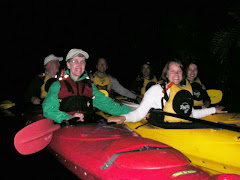
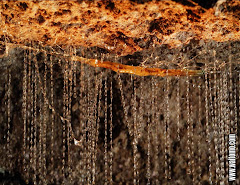
We walked around the Mount a few times and up it as well. Cory clearly gets his photography skills from his dad, so these trips included plenty of photo ops. One event that was difficult to get photographic evidence of, though, was our nighttime kayak to see glowworms. Kayaking in the dark is certainly a little challenging, especially when the lake water is low, and you have to avoid sandbars and shallow areas. But the glowworms were fantastic. It was difficult to discriminate where the glowworms stopped and the stars in the night sky began. It was really beautiful.
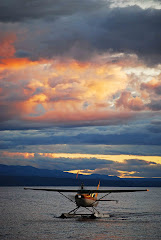
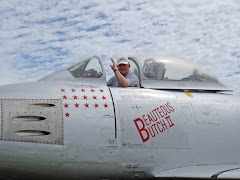
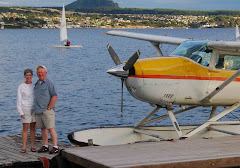
Gary is a pilot, so we spent some time exploring the local aviation museum, complete with a glider trip for him. He soared above Tauranga, the port, and Mount Maunganui. Cory had also planned a surprise sunset float plane trip over Lake Taupo for both Gary and Karen. (The last time Gary landed in water, it was upside-down and unplanned, so we were glad to see he didn’t suffer any sort of flashback!)
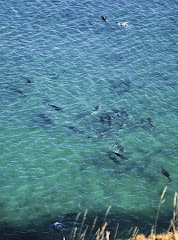
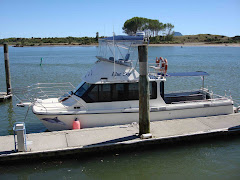
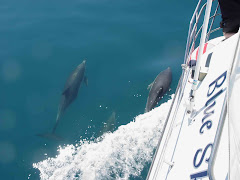
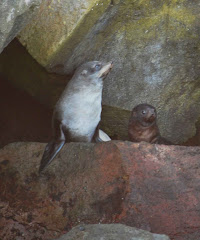
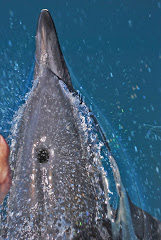
One highlight of the adventures was swimming with dolphins. We all loaded into the boat, “Blue Sky”, and sailed out into the ocean east of Whakatane. We spotted dolphins and were able to swim with them a few different times, though we never got closer than several meters away. Sitting on the bow of the boat, though, and watching them race along in front of us, weaving in and out, was magical. Both Cory and I got splashed when a dolphin blew out of its blowhole, and one even brushed Cory’s foot with its fin. We also got to swim with fur seals. We were probably within a foot (or less) of these big girls! The skipper said they like to play “chicken”, and will swim right at you to see who will turn away. Definitely true, and I definitely lost every test of will.
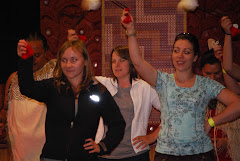
Another highlight was the bi-annual national Kapa Haka festival. It was held in Tauranga this year, and showcased 36 kapa haka teams from around New Zealand. These teams each put on about a 30 minute performance, showcasing their talents. I still get goose bumps every time I hear a haka, and the other pieces were equally awesome.
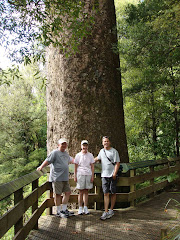
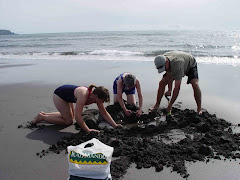
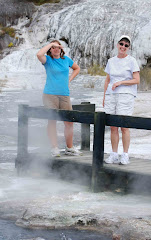
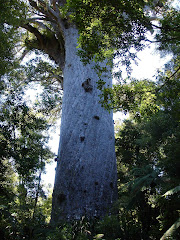
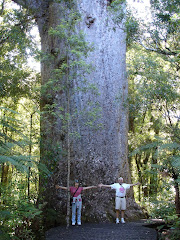
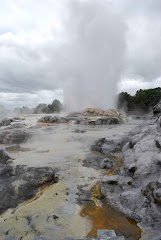
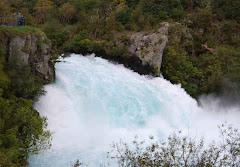
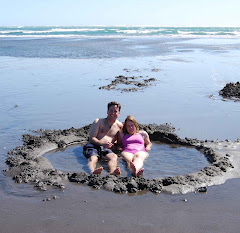
We revisited some favorite locations with Gary and Karen as well, seeing Orakei Korako, a thermal park near Taupo; the black sand beaches of Kawhia, where we dug our own hot pool; the rushing waters of Huka Falls; the kauri trees in the Kaimai forest; the local harbor, via the ferry; and Rainbow Springs, an animal park in Rotorua.
Tomorrow, we head to Auckland, as Gary and Karen soon fly out for home. They are the last of our summer visitors, making it official that summer is almost over here. The good news, though, for those of you in the northern hemisphere, is that winter, then, is almost over!
We walked around the Mount a few times and up it as well. Cory clearly gets his photography skills from his dad, so these trips included plenty of photo ops. One event that was difficult to get photographic evidence of, though, was our nighttime kayak to see glowworms. Kayaking in the dark is certainly a little challenging, especially when the lake water is low, and you have to avoid sandbars and shallow areas. But the glowworms were fantastic. It was difficult to discriminate where the glowworms stopped and the stars in the night sky began. It was really beautiful.
Gary is a pilot, so we spent some time exploring the local aviation museum, complete with a glider trip for him. He soared above Tauranga, the port, and Mount Maunganui. Cory had also planned a surprise sunset float plane trip over Lake Taupo for both Gary and Karen. (The last time Gary landed in water, it was upside-down and unplanned, so we were glad to see he didn’t suffer any sort of flashback!)
One highlight of the adventures was swimming with dolphins. We all loaded into the boat, “Blue Sky”, and sailed out into the ocean east of Whakatane. We spotted dolphins and were able to swim with them a few different times, though we never got closer than several meters away. Sitting on the bow of the boat, though, and watching them race along in front of us, weaving in and out, was magical. Both Cory and I got splashed when a dolphin blew out of its blowhole, and one even brushed Cory’s foot with its fin. We also got to swim with fur seals. We were probably within a foot (or less) of these big girls! The skipper said they like to play “chicken”, and will swim right at you to see who will turn away. Definitely true, and I definitely lost every test of will.
Another highlight was the bi-annual national Kapa Haka festival. It was held in Tauranga this year, and showcased 36 kapa haka teams from around New Zealand. These teams each put on about a 30 minute performance, showcasing their talents. I still get goose bumps every time I hear a haka, and the other pieces were equally awesome.
We revisited some favorite locations with Gary and Karen as well, seeing Orakei Korako, a thermal park near Taupo; the black sand beaches of Kawhia, where we dug our own hot pool; the rushing waters of Huka Falls; the kauri trees in the Kaimai forest; the local harbor, via the ferry; and Rainbow Springs, an animal park in Rotorua.
Tomorrow, we head to Auckland, as Gary and Karen soon fly out for home. They are the last of our summer visitors, making it official that summer is almost over here. The good news, though, for those of you in the northern hemisphere, is that winter, then, is almost over!
Monday, February 16, 2009
Happy Valentine's Day!
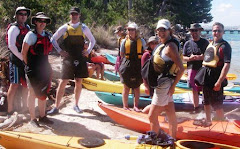
Cory and I joined a local kayaking club, and this weekend was our requisite introductory course. Because it fell on Valentine’s Day, we called it our gift to each other…really, how much more romantic can you get than a near-death experience?
The two-day course was focused on teaching safety and technique. There were six others in the group and our instructor, Robbie. Robbie has been kayaking for about 20 years, and she has recently done some very long solo kayak trips. You felt like you were probably in good hands with her expertise.
The first half of Saturday was spent in a local indoor pool working on safe exits from capsized kayaks and re-entries from the water. We unloaded kayaks; dug out buoyancy vests, spray skirts, and paddles; and got instruction on all of the above. A spray skirt, for those of you who stick with canoeing, is pretty much what it sounds like. It looks a little like a misshapen skirt with suspenders attached. The waist cinches in, and the edges of the skirt stretch to fit the edge of the kayak’s cockpit, thus allowing you a fairly dry ride. The trick that we were going to start with was getting your spray skirt off and you out of the kayak should you flip over.
If you’ve canoed, you know that rocking yourself back and forth in the boat isn’t exactly a good idea, but that it is pretty difficult to force yourself to tip over doing just this. Well, in a kayak, you can pretty much give yourself a little rock and a little lean and end up helm up-head down pretty quickly. So to acclimatize ourselves to this, we hopped in the water with a kayak and a partner. The plan was to have one person in the kayak and the other in the pool. The partner in the pool would flip the kayak over; the person in the kayak would plunge underwater, then give a signal. The pool partner would flip their partner back up, safe and sound.
Cory hopped in the kayak first, as I got into the pool. He was the demonstrator, as our instructor showed us how this was to work. Then it was our turn. On the count of three, I flipped Cory over. He gave the signal, and I popped him back up. Most of the way, that is. Actually, I popped him back up so that he was sideways, barely out of the water, and then sort of dropped him back in. I couldn’t get him up! I honestly can’t remember if he got himself out of the spray skirt, or the instructor was right there and flipped him back up. Cory was fine, maybe only a teensy bit mad, but I was totally shook up. Imagine drowning your own husband – and on Valentine’s Day!
Luckily he survived and no further incidents occurred. We progressed through the rest of our training with success. Exiting the kayak after a roll by popping your spray skirt off and coming up next to the side of the boat was a breeze. Even the water re-entries, where you have to pop yourself back onto the boat and shimmy into your cockpit went okay. In fact, we won the entry/exit relay race. I did sort of feel I needed to redeem myself after the near drowning incident.
And that was just the morning. After a lunch and kayaking gear talk, we headed out to the Tauranga Harbor. We were to learn the basic paddle strokes and get a little experience with current and wind. There is actually a proper way to get into a kayak from the shore, and this was demonstrated for us. It is sort of an ungainly method where you use your paddle as a prop. You sit on the paddle and sort of scoot yourself into the kayak’s cockpit, making sure not to lean away from the paddle. That part about not leaning away from the paddle is pretty important. Again, I displayed my athletic prowess by falling off the kayak, leaning away from that damn paddle, into about one foot of water! Seriously, I haven’t even got the kayak into the water yet, and I’ve capsized. Unbelievable.
Cory and the instructor were kind enough to suggest that it was because the helm of my kayak was shaped differently than the others’ – that the v-shape made it prone to such incidents. And the other group members pretended not to have seen, which was kind, I suppose. Normally, in the event of such an embarrassing occurrence, I prefer everyone at least have a good laugh with me. Oh well, perhaps they saved their laughter for later…
The paddling techniques were a success though, and I could move about the water with relative success. We learned paddle strokes for moving forward, backward, turning in place, turning while moving, and moving sideways.
Paddling in the sea was pretty different than in a lake or river. We were in a small area of the harbor, all trying to avoid each other and the large boats that are moored there. I was occasionally disoriented as we drifted past large, anchored boats. I was convinced they were moving towards us, when, in fact we were floating in the current past them. I felt like the narrarator in Poe’s “The Tell-Tale Heart” for a few moments.
The rest of the day passed without further incident, and we shored our kayaks and loaded them up. I was tired, but not sore. I thought steering a kayak, even without using the rudder, as we had that afternoon, was easier than steering a canoe. I have no idea how to J-stroke, even though it has been explained to me numerous times. So even after a few fiascos, I felt like I’d done okay. Both Cory and I were alive, no thanks to me, so that was also considered a success…
The next morning, we were headed out for a day trip. We had a brief lecture on safety and trip planning, then loaded up and headed to Sulphur Point marina. Getting a group of kayaks, along with all the gear, loaded and unloaded is no quick task. After getting kayaks on and off the truck, we had to distribute buoyancy vests, spray skirts, paddles, visibility flags, food, and water.
Our trip involved crossing the main boating channel, cruising along Matakana Island, and stopping for lunch. After we adjusted foot pedals and checked rudders, we were finally ready to go. We launched off the shore, no one fell in, and we were off! The wind was blowing at about 10 knots (which I learned is about 20 kph or 12 mph), and between wind, current, and boats, there were little waves to cut through.
Another student dutifully took over my role as class disaster, which I much appreciated. (She had no idea how to use her rudder apparently, and was drifting away from the group.) We crossed the channel and then cruised along the shore of the island. It was a pretty easy paddle, and we chatted with one another as we enjoyed the views and the weather. We stopped for a quick snack, and then paddled further along before stopping for lunch. We had a leisurely meal, with a few people enjoying a swim, before packing up and heading back.
It was a really enjoyable weekend, with only a few sore muscles on Sunday night. And when Cory’s mom and dad come this week, we even have a little kayak trip planned for them!
The two-day course was focused on teaching safety and technique. There were six others in the group and our instructor, Robbie. Robbie has been kayaking for about 20 years, and she has recently done some very long solo kayak trips. You felt like you were probably in good hands with her expertise.
The first half of Saturday was spent in a local indoor pool working on safe exits from capsized kayaks and re-entries from the water. We unloaded kayaks; dug out buoyancy vests, spray skirts, and paddles; and got instruction on all of the above. A spray skirt, for those of you who stick with canoeing, is pretty much what it sounds like. It looks a little like a misshapen skirt with suspenders attached. The waist cinches in, and the edges of the skirt stretch to fit the edge of the kayak’s cockpit, thus allowing you a fairly dry ride. The trick that we were going to start with was getting your spray skirt off and you out of the kayak should you flip over.
If you’ve canoed, you know that rocking yourself back and forth in the boat isn’t exactly a good idea, but that it is pretty difficult to force yourself to tip over doing just this. Well, in a kayak, you can pretty much give yourself a little rock and a little lean and end up helm up-head down pretty quickly. So to acclimatize ourselves to this, we hopped in the water with a kayak and a partner. The plan was to have one person in the kayak and the other in the pool. The partner in the pool would flip the kayak over; the person in the kayak would plunge underwater, then give a signal. The pool partner would flip their partner back up, safe and sound.
Cory hopped in the kayak first, as I got into the pool. He was the demonstrator, as our instructor showed us how this was to work. Then it was our turn. On the count of three, I flipped Cory over. He gave the signal, and I popped him back up. Most of the way, that is. Actually, I popped him back up so that he was sideways, barely out of the water, and then sort of dropped him back in. I couldn’t get him up! I honestly can’t remember if he got himself out of the spray skirt, or the instructor was right there and flipped him back up. Cory was fine, maybe only a teensy bit mad, but I was totally shook up. Imagine drowning your own husband – and on Valentine’s Day!
Luckily he survived and no further incidents occurred. We progressed through the rest of our training with success. Exiting the kayak after a roll by popping your spray skirt off and coming up next to the side of the boat was a breeze. Even the water re-entries, where you have to pop yourself back onto the boat and shimmy into your cockpit went okay. In fact, we won the entry/exit relay race. I did sort of feel I needed to redeem myself after the near drowning incident.
And that was just the morning. After a lunch and kayaking gear talk, we headed out to the Tauranga Harbor. We were to learn the basic paddle strokes and get a little experience with current and wind. There is actually a proper way to get into a kayak from the shore, and this was demonstrated for us. It is sort of an ungainly method where you use your paddle as a prop. You sit on the paddle and sort of scoot yourself into the kayak’s cockpit, making sure not to lean away from the paddle. That part about not leaning away from the paddle is pretty important. Again, I displayed my athletic prowess by falling off the kayak, leaning away from that damn paddle, into about one foot of water! Seriously, I haven’t even got the kayak into the water yet, and I’ve capsized. Unbelievable.
Cory and the instructor were kind enough to suggest that it was because the helm of my kayak was shaped differently than the others’ – that the v-shape made it prone to such incidents. And the other group members pretended not to have seen, which was kind, I suppose. Normally, in the event of such an embarrassing occurrence, I prefer everyone at least have a good laugh with me. Oh well, perhaps they saved their laughter for later…
The paddling techniques were a success though, and I could move about the water with relative success. We learned paddle strokes for moving forward, backward, turning in place, turning while moving, and moving sideways.
Paddling in the sea was pretty different than in a lake or river. We were in a small area of the harbor, all trying to avoid each other and the large boats that are moored there. I was occasionally disoriented as we drifted past large, anchored boats. I was convinced they were moving towards us, when, in fact we were floating in the current past them. I felt like the narrarator in Poe’s “The Tell-Tale Heart” for a few moments.
The rest of the day passed without further incident, and we shored our kayaks and loaded them up. I was tired, but not sore. I thought steering a kayak, even without using the rudder, as we had that afternoon, was easier than steering a canoe. I have no idea how to J-stroke, even though it has been explained to me numerous times. So even after a few fiascos, I felt like I’d done okay. Both Cory and I were alive, no thanks to me, so that was also considered a success…
The next morning, we were headed out for a day trip. We had a brief lecture on safety and trip planning, then loaded up and headed to Sulphur Point marina. Getting a group of kayaks, along with all the gear, loaded and unloaded is no quick task. After getting kayaks on and off the truck, we had to distribute buoyancy vests, spray skirts, paddles, visibility flags, food, and water.
Our trip involved crossing the main boating channel, cruising along Matakana Island, and stopping for lunch. After we adjusted foot pedals and checked rudders, we were finally ready to go. We launched off the shore, no one fell in, and we were off! The wind was blowing at about 10 knots (which I learned is about 20 kph or 12 mph), and between wind, current, and boats, there were little waves to cut through.
Another student dutifully took over my role as class disaster, which I much appreciated. (She had no idea how to use her rudder apparently, and was drifting away from the group.) We crossed the channel and then cruised along the shore of the island. It was a pretty easy paddle, and we chatted with one another as we enjoyed the views and the weather. We stopped for a quick snack, and then paddled further along before stopping for lunch. We had a leisurely meal, with a few people enjoying a swim, before packing up and heading back.
It was a really enjoyable weekend, with only a few sore muscles on Sunday night. And when Cory’s mom and dad come this week, we even have a little kayak trip planned for them!
Friday, January 30, 2009
South Island Trip: Unabridged Version
(Warning: This blog post is extreme in length, and may cause the reader to become drowsy and/or attached to the seating beneath them.)
We recently got back from our 10-day trip to New Zealand’s South Island. Cory and I have been wanting to go, and my parents had some of the South Island sights on their “must-see” list, so their trip was the perfect impetus.
I should start of by saying that I got little input from the others on our trip; Mom and Dad were pretty overwhelmed with planning their trip to NZ all ready, and Cory isn’t big on advance decision making when it comes to travel. I’d heard that during the summer months, it could get quite crowded in the South Island, so it was advised you book accommodations, etc well ahead.
So with that warning ringing in my ears and too many guide books to peruse, I started planning this trip in October; I know that this is very dorky, but I couldn’t help myself. There is a lot to see in the South Island and everyone has their input on what spots you “have to go to”. I was perhaps a little over-ambitious in mapping out our route. But there really are so many places you “have to go to”! Turns out that, on top of two airplane flights, a three-hour ferry ride, and a cross-country train journey, we also drove 2505 kilometers. (For those of you who don’t do metric, that is about 1500 miles.) Most surprising, during our trip, no one tried to strangle me or push me out of the moving car!
We pretty much circumnavigated the South Island, though we did cheat, and cut off the very southern tip. (I’d planned to go there, but got a sense from my traveling companions that it might have to be sacrificed in the name of sanity.) I have decided against giving you a detailed, day-by-day account (though I did keep a “paper blog” so I could do so upon request) and will instead try to narrow it down to the highest of highlights…
Flying south into Wellington, the nation’s capital, at the very tip of North Island, was pretty much like taking a scenic flight – you could watch the orchards pass by, get a great view of giant Lake Taupo, and see into the craters of the Tongariro Mountains. Wellington itself is the coziest larger city we’ve been in since arriving in NZ. There just aren’t that many large cities, with a national population of 4 million. Auckland has a population of about 1 million, making it decidedly un-cozy.
We hit a great museum, Te Papa, which had something for everyone – modern art, historical artifacts, natural history displays, cultural exhibits… Then we took a cable car up to the botanical gardens, and spent the afternoon wandering along, not minding if we didn’t know exactly where we are at. Anytime you can get lost in a garden, you are in a good place. The day was topped off by Cory’s selection of a pizza place that actually satisfied his craving for pizza as it should be.
We enjoyed the city more the next day, visiting a farmer’s market, watching street performers, eating crepes, poking around in shops, and hoping our taxi driver wouldn’t run down the pedestrians. We did make it safely to the ferry terminal, where we boarded the Arahura. We sailed, peering out the salt-sprayed windows with binocs, across Cook Strait. Mom and I toasted the evening’s trip with a glass of wine just before we came into port.
We picked up our rental car the next morning, along with some groceries for lunches on the go. Then we took a small boat through the Queen Charlotte’s Sound, before our short hike. We spotted several wekas, which are little brown birds that sort of resemble a chicken, but are very inquisitive and, apparently, fairly oblivious. One walked right by Mom, on a little footpath, before spotting me. After a picnic lunch, the plan was for another boat to pick us up and return us to the wharf that we’d departed from that morning. Apparently, though, the “water taxi” run by this same company had broken down, and the boat we were on was doing double-duty. We stopped at every bay and cove imaginable. (And, sometime, when you’ve got the atlas out, look at that northeastern coastline of the South Island – there are more than a couple of bays and coves!) It was neat, though… We took people home from work, dropped folks off at their holiday cribs, watched a woman unload boxes of groceries bought in town, and, in general sailed slowly back and forth among the sounds for about three hours.
The next day we had sort of a similar water cruise/hike in the Abel Tasman area. And, before we even got on the boat, we saw a little blue penguin playing in the surf! We spotted a few fur seals, too, lazing on the rocks in the sun. The rest of the day did not disappoint either, with plenty of sandy beaches to explore and rainforest-like bush to wander through.
The next morning, we caught part of a newscast of Obama’s inauguration; people in New Zealand are almost as excited as Americans about our new president! After that good start, we drove into Christchurch to see the International Antarctic Center. Christchurch is the shipping off point for many people working and studying at the South Pole. The Center had some really great displays, including educational displays, a mock camp set-up, a home for injured penguins, a “cold zone” (where they had real snow, cold temps, and wind like Iowa’s)!
After another little drive, we stopped to see the Moeraki Boulders. We have pictures, which do give you some sense of scale, but it’s difficult to do these unusual, spherical rocks, strewn along a beach justice in a description. Some use the term “other-worldly”, which isn’t really right. Maybe you’ll just have to come see them for yourself.
Then that evening, we went to a penguin blind at Nugget Bay. The very rare yellow-eyed penguins often nest here, and we were hoping to see some. We had our binoculars and cameras, and we were able to put them to good use! We saw at least eight penguins come in from the ocean and toddle up to their nests in the rocks or the grassy slope! We were also able to spot 2 seals, one lazing on the shore and the other playing (or hunting) in the surf of the bay.
In the morning, we decided to see if we could keep our luck going and headed to Surat Bay. We took a short walk along the grassy slopes above the beach, on our way to look for sea lions. To our surprise, Mom actually spotted one in the grass that Cory and I had walked right by – within a meter of it, probably! Luckily for us, it was sleeping, and we hadn’t woken it. Rumor has it, sea lions do not like their naps interrupted. Down on the beach, we saw another one, and could see flipper tracks in the sand of many more sea lions that had come into nap.
Our next destination was the Milford Sound area on the southwestern coast. (If you are following on a map, and please tell me you’re not, we’d by now traveled much of the short, northern coast and all of the eastern coast of the South Island. And everyone was still speaking to me…) During our drive across the Canterbury Plains, Mom snapped photos from the car – sheep, sheep, deer farms, sheep, hedges, sheep, hedges, tussock, hedges, and sheep mostly. We stopped that afternoon to do laundry and take a break from the road. We ended up having dinner at an Italian place (another good pizza for Cory) before heading off again.
While the Sounds themselves are the highlight, the drive towards them is almost as impressive. We stopped at one lookout to get a better glimpse of the mountains, and were greeted by a kea, the only alpine parrot. They are nosy and sociable birds, legendary for picking apart windshield wipers as cars wait in line to enter the Homer Tunnel (a narrow, one-lane tunnel – always a really good idea). We also encountered a somewhat less likeable animal, the infamous sandfly. Small and mean, these little buggers could just about drive you mad. I’m sure they have actually driven someone mad at some point, and I came close to joining them. I am still scratching at bites and occasionally have a flashback and begin swatting at myself.
Milford Sound is actually a fiord (yes, they spell it with an “i” not a “j” here), the difference being that sounds are carved by rivers heading towards the ocean, whereas fiords are carved by glaciers and then filled in by ocean waters. (Save that little tidbit of info for trivia night!) After a rain, the walls of the fiords have over 10,000 waterfalls cascading down them. We saw a pretty good selection of them the day we visited and were even spared the rain!
On our walk from the car park, Mom spotted another pretty rare penguin, the Fiordland Crested. Again, Cory and I would have walked right on by. Thank goodness Mom sees these things! We also saw three groups of seals, dusky dolphins, and Australian gannets out in the fiords. Then, we stopped off at Milford’s Underwater Observatory. Because of the unusual layering of tannin-stained freshwater layering over salt water in the Milford Sound, sea creatures that are normally found at a much greater depth are visible only a few meters under the surface. To view these, the Underwater Observatory was built, letting the public venture a few stories underwater to see things like sea cucumbers, eleven-legged starfish, snake starfish, rare black and red coral, tube anemone, a variety of fish, and even squid eggs!
After a full day, we drove northwards to Queenstown, and then, the next day, on toward the Fox Glacier. No where else are there such easily accessible glaciers surrounded by such lush forests. We walked a short half-hour to get within 80 meters of the terminal face of the glacier – as close as you would want to get due to avalanches and rock slides. We heard rocks or ice fall from the glacier as we stood there, taking in the blue, blue ice and the piles of snow.
The Franz Joseph Glacier is just a bit further north. We hiked over a rock-strewn river bed to within 200 meters of its terminal face. This allowed a view back into the steep-sided walls that held the glaciers bulk. The areas for visitors are well-marked, and, as we stood their gawking at it, a group of guides came marching past. They lead groups out on areas of the glacier and, with their red shirts and large pick axes, were going out to scout out the safest routes. We enjoyed the view from where we were.
We then drove on towards Greymouth, where we dropped off the car and caught the train. The TranzAlpine crossed the island from east to west and back each day. On its route over the Southern Alps, it crossed over four viaducts and nineteen tunnels. Standing in the open-air observation car while passing through a tunnel offered a childish thrill (and left me lightly coated with black soot)!
The next morning we breakfasted at Drexel’s in Christchurch, where they had “Iowa Pancakes” on the menu. The original owner used the pancake recipe of his Iowan grandma – a taste of home! Not only were they delicious, but they gave us enough energy to explore the campus of the Arts Center all morning. We caught a taxi in enough time to get us to the airport for our flight back to Tauranga.
Whew!
We recently got back from our 10-day trip to New Zealand’s South Island. Cory and I have been wanting to go, and my parents had some of the South Island sights on their “must-see” list, so their trip was the perfect impetus.
I should start of by saying that I got little input from the others on our trip; Mom and Dad were pretty overwhelmed with planning their trip to NZ all ready, and Cory isn’t big on advance decision making when it comes to travel. I’d heard that during the summer months, it could get quite crowded in the South Island, so it was advised you book accommodations, etc well ahead.
So with that warning ringing in my ears and too many guide books to peruse, I started planning this trip in October; I know that this is very dorky, but I couldn’t help myself. There is a lot to see in the South Island and everyone has their input on what spots you “have to go to”. I was perhaps a little over-ambitious in mapping out our route. But there really are so many places you “have to go to”! Turns out that, on top of two airplane flights, a three-hour ferry ride, and a cross-country train journey, we also drove 2505 kilometers. (For those of you who don’t do metric, that is about 1500 miles.) Most surprising, during our trip, no one tried to strangle me or push me out of the moving car!
We pretty much circumnavigated the South Island, though we did cheat, and cut off the very southern tip. (I’d planned to go there, but got a sense from my traveling companions that it might have to be sacrificed in the name of sanity.) I have decided against giving you a detailed, day-by-day account (though I did keep a “paper blog” so I could do so upon request) and will instead try to narrow it down to the highest of highlights…
Flying south into Wellington, the nation’s capital, at the very tip of North Island, was pretty much like taking a scenic flight – you could watch the orchards pass by, get a great view of giant Lake Taupo, and see into the craters of the Tongariro Mountains. Wellington itself is the coziest larger city we’ve been in since arriving in NZ. There just aren’t that many large cities, with a national population of 4 million. Auckland has a population of about 1 million, making it decidedly un-cozy.
We hit a great museum, Te Papa, which had something for everyone – modern art, historical artifacts, natural history displays, cultural exhibits… Then we took a cable car up to the botanical gardens, and spent the afternoon wandering along, not minding if we didn’t know exactly where we are at. Anytime you can get lost in a garden, you are in a good place. The day was topped off by Cory’s selection of a pizza place that actually satisfied his craving for pizza as it should be.
We enjoyed the city more the next day, visiting a farmer’s market, watching street performers, eating crepes, poking around in shops, and hoping our taxi driver wouldn’t run down the pedestrians. We did make it safely to the ferry terminal, where we boarded the Arahura. We sailed, peering out the salt-sprayed windows with binocs, across Cook Strait. Mom and I toasted the evening’s trip with a glass of wine just before we came into port.
We picked up our rental car the next morning, along with some groceries for lunches on the go. Then we took a small boat through the Queen Charlotte’s Sound, before our short hike. We spotted several wekas, which are little brown birds that sort of resemble a chicken, but are very inquisitive and, apparently, fairly oblivious. One walked right by Mom, on a little footpath, before spotting me. After a picnic lunch, the plan was for another boat to pick us up and return us to the wharf that we’d departed from that morning. Apparently, though, the “water taxi” run by this same company had broken down, and the boat we were on was doing double-duty. We stopped at every bay and cove imaginable. (And, sometime, when you’ve got the atlas out, look at that northeastern coastline of the South Island – there are more than a couple of bays and coves!) It was neat, though… We took people home from work, dropped folks off at their holiday cribs, watched a woman unload boxes of groceries bought in town, and, in general sailed slowly back and forth among the sounds for about three hours.
The next day we had sort of a similar water cruise/hike in the Abel Tasman area. And, before we even got on the boat, we saw a little blue penguin playing in the surf! We spotted a few fur seals, too, lazing on the rocks in the sun. The rest of the day did not disappoint either, with plenty of sandy beaches to explore and rainforest-like bush to wander through.
The next morning, we caught part of a newscast of Obama’s inauguration; people in New Zealand are almost as excited as Americans about our new president! After that good start, we drove into Christchurch to see the International Antarctic Center. Christchurch is the shipping off point for many people working and studying at the South Pole. The Center had some really great displays, including educational displays, a mock camp set-up, a home for injured penguins, a “cold zone” (where they had real snow, cold temps, and wind like Iowa’s)!
After another little drive, we stopped to see the Moeraki Boulders. We have pictures, which do give you some sense of scale, but it’s difficult to do these unusual, spherical rocks, strewn along a beach justice in a description. Some use the term “other-worldly”, which isn’t really right. Maybe you’ll just have to come see them for yourself.
Then that evening, we went to a penguin blind at Nugget Bay. The very rare yellow-eyed penguins often nest here, and we were hoping to see some. We had our binoculars and cameras, and we were able to put them to good use! We saw at least eight penguins come in from the ocean and toddle up to their nests in the rocks or the grassy slope! We were also able to spot 2 seals, one lazing on the shore and the other playing (or hunting) in the surf of the bay.
In the morning, we decided to see if we could keep our luck going and headed to Surat Bay. We took a short walk along the grassy slopes above the beach, on our way to look for sea lions. To our surprise, Mom actually spotted one in the grass that Cory and I had walked right by – within a meter of it, probably! Luckily for us, it was sleeping, and we hadn’t woken it. Rumor has it, sea lions do not like their naps interrupted. Down on the beach, we saw another one, and could see flipper tracks in the sand of many more sea lions that had come into nap.
Our next destination was the Milford Sound area on the southwestern coast. (If you are following on a map, and please tell me you’re not, we’d by now traveled much of the short, northern coast and all of the eastern coast of the South Island. And everyone was still speaking to me…) During our drive across the Canterbury Plains, Mom snapped photos from the car – sheep, sheep, deer farms, sheep, hedges, sheep, hedges, tussock, hedges, and sheep mostly. We stopped that afternoon to do laundry and take a break from the road. We ended up having dinner at an Italian place (another good pizza for Cory) before heading off again.
While the Sounds themselves are the highlight, the drive towards them is almost as impressive. We stopped at one lookout to get a better glimpse of the mountains, and were greeted by a kea, the only alpine parrot. They are nosy and sociable birds, legendary for picking apart windshield wipers as cars wait in line to enter the Homer Tunnel (a narrow, one-lane tunnel – always a really good idea). We also encountered a somewhat less likeable animal, the infamous sandfly. Small and mean, these little buggers could just about drive you mad. I’m sure they have actually driven someone mad at some point, and I came close to joining them. I am still scratching at bites and occasionally have a flashback and begin swatting at myself.
Milford Sound is actually a fiord (yes, they spell it with an “i” not a “j” here), the difference being that sounds are carved by rivers heading towards the ocean, whereas fiords are carved by glaciers and then filled in by ocean waters. (Save that little tidbit of info for trivia night!) After a rain, the walls of the fiords have over 10,000 waterfalls cascading down them. We saw a pretty good selection of them the day we visited and were even spared the rain!
On our walk from the car park, Mom spotted another pretty rare penguin, the Fiordland Crested. Again, Cory and I would have walked right on by. Thank goodness Mom sees these things! We also saw three groups of seals, dusky dolphins, and Australian gannets out in the fiords. Then, we stopped off at Milford’s Underwater Observatory. Because of the unusual layering of tannin-stained freshwater layering over salt water in the Milford Sound, sea creatures that are normally found at a much greater depth are visible only a few meters under the surface. To view these, the Underwater Observatory was built, letting the public venture a few stories underwater to see things like sea cucumbers, eleven-legged starfish, snake starfish, rare black and red coral, tube anemone, a variety of fish, and even squid eggs!
After a full day, we drove northwards to Queenstown, and then, the next day, on toward the Fox Glacier. No where else are there such easily accessible glaciers surrounded by such lush forests. We walked a short half-hour to get within 80 meters of the terminal face of the glacier – as close as you would want to get due to avalanches and rock slides. We heard rocks or ice fall from the glacier as we stood there, taking in the blue, blue ice and the piles of snow.
The Franz Joseph Glacier is just a bit further north. We hiked over a rock-strewn river bed to within 200 meters of its terminal face. This allowed a view back into the steep-sided walls that held the glaciers bulk. The areas for visitors are well-marked, and, as we stood their gawking at it, a group of guides came marching past. They lead groups out on areas of the glacier and, with their red shirts and large pick axes, were going out to scout out the safest routes. We enjoyed the view from where we were.
We then drove on towards Greymouth, where we dropped off the car and caught the train. The TranzAlpine crossed the island from east to west and back each day. On its route over the Southern Alps, it crossed over four viaducts and nineteen tunnels. Standing in the open-air observation car while passing through a tunnel offered a childish thrill (and left me lightly coated with black soot)!
The next morning we breakfasted at Drexel’s in Christchurch, where they had “Iowa Pancakes” on the menu. The original owner used the pancake recipe of his Iowan grandma – a taste of home! Not only were they delicious, but they gave us enough energy to explore the campus of the Arts Center all morning. We caught a taxi in enough time to get us to the airport for our flight back to Tauranga.
Whew!
Thursday, January 29, 2009
South Island Trip: Abridged Version
We recently got back from our 10-day trip to New Zealand’s South Island. Cory and I have been wanting to go, and my parents had some of the South Island sights on their “must-see” list, so their trip was the perfect impetus.
It was a really great trip, and we saw a lot of cool stuff. We also drove sort of a lot…
It was a really great trip, and we saw a lot of cool stuff. We also drove sort of a lot…
Thursday, January 22, 2009
South Island exploring
We've been traveling the South Island these past five days - we started in Wellington then took the ferry through Cook Strait to Picton. Lots of adventures to tell, but we'll save those for a lengthier post when we return. Mom and Dad are easy-going travelers, and no one has become physically violent towards the tour guide (me) yet - all good signs!
Friday, January 16, 2009
Touring Tauranga
Mom and Dad have been here this week and we’ve been exploring the Tauranga area and beyond. I’m trying to take it easy on them, hoping they’ll be prepared for our 10 days traveling in the South Island. (I’ve created an itinerary that has been referred to as “grueling” – but there is so much to see! I may give up this whole teaching thing and focus on tourism instead.)
After our nice weekend, Cory had to return to work, while Mom, Dad, and I filled our days with touristy activities. It’s been fabulous – we’ve taken a million pictures or so, too...
Monday: Dad and I ran along the beach in the morning. After breakfast, we hit the road. Our first stop was a local garden shop. Mom and Dad have been identifying plants left and right. Then we went to Mossop’s Honey, where, after a long time spent chatting with the clerk, she sent us out the door with ice cream cones (“Well, you can have that, but let me just put a little taste of this…and this…and this… There!”) With full bellies, we headed into town to the Tauranga quilting shop. Mom found some great fabric, and a Kiwi quilt is in the works. In the afternoon we checked out the tide pools and the wharf during low tide. We spotted crabs, jellyfish, and, most exciting, a sting ray!
Tuesday: We hiked up to the summit of Mount Maunganui in the morning. The walk was a little steep, but the views were great. We rewarded ourselves with giant ice cream cones from Copenhagen Cones at 10:30 in the morning. (There was no line, though, and this is unheard of – you have to take the advantage when opportunity knocks. Plus, that was a long walk up!) After recovering, we got hopped on a bus and took a tour of the Port of Tauranga. It was really fascinating. Afterwards, we shopped in downtown Maunganui, picking up souvenirs and postcards.
Wednesday: We headed out over the Kaimai mountain range towards the west. Our first stop was the Gordonton quilt shop, where Mom picked up more fabric for her quilt. Then we headed to the Hamilton Gardens. It was a perfect day to wander around the gardens, but Dad burned the top of his feet after insisting that he was going to wear his sandals all day. That night, Mom and Dad had their Burger Fuel “experience” – they, too, are hooked.
Thursday: Dad and I skipped our run this morning, instead opting for a coffee at a café. Then we suited up and headed to the beach. Dad and I tried to ride in on the waves, while Mom people-watched. That afternoon, Dad napped (worn out from all that surf) while Mom and I checked out the local Department of Conservation office and searched for plant guides. That night we ate dinner on the deck before heading to the Mount Hot Pools.
Friday: A cruise ship had arrived early this morning and Mom and Dad were awed with its size. After a quick run around the Mount, we did some laundry and started to pack for our big South Island trip. In the afternoon, we hopped on the Spirit of Tauranga, a ferry that runs between the Mount and Tauranga. We had a great ride, with fantastic views. For dinner, we ate at the Lobster Club. Dad and Cory had the fresh fish, while Mom and I split the seafood platter for two. It should have been listed as seafood platter for 4+, but with help, we did manage to do some damage – crayfish, crab legs, prawns, shrimp, scallops, oysters, mussels, pipis, salmon, tuna, snapper… Oy!
After our nice weekend, Cory had to return to work, while Mom, Dad, and I filled our days with touristy activities. It’s been fabulous – we’ve taken a million pictures or so, too...
Monday: Dad and I ran along the beach in the morning. After breakfast, we hit the road. Our first stop was a local garden shop. Mom and Dad have been identifying plants left and right. Then we went to Mossop’s Honey, where, after a long time spent chatting with the clerk, she sent us out the door with ice cream cones (“Well, you can have that, but let me just put a little taste of this…and this…and this… There!”) With full bellies, we headed into town to the Tauranga quilting shop. Mom found some great fabric, and a Kiwi quilt is in the works. In the afternoon we checked out the tide pools and the wharf during low tide. We spotted crabs, jellyfish, and, most exciting, a sting ray!
Tuesday: We hiked up to the summit of Mount Maunganui in the morning. The walk was a little steep, but the views were great. We rewarded ourselves with giant ice cream cones from Copenhagen Cones at 10:30 in the morning. (There was no line, though, and this is unheard of – you have to take the advantage when opportunity knocks. Plus, that was a long walk up!) After recovering, we got hopped on a bus and took a tour of the Port of Tauranga. It was really fascinating. Afterwards, we shopped in downtown Maunganui, picking up souvenirs and postcards.
Wednesday: We headed out over the Kaimai mountain range towards the west. Our first stop was the Gordonton quilt shop, where Mom picked up more fabric for her quilt. Then we headed to the Hamilton Gardens. It was a perfect day to wander around the gardens, but Dad burned the top of his feet after insisting that he was going to wear his sandals all day. That night, Mom and Dad had their Burger Fuel “experience” – they, too, are hooked.
Thursday: Dad and I skipped our run this morning, instead opting for a coffee at a café. Then we suited up and headed to the beach. Dad and I tried to ride in on the waves, while Mom people-watched. That afternoon, Dad napped (worn out from all that surf) while Mom and I checked out the local Department of Conservation office and searched for plant guides. That night we ate dinner on the deck before heading to the Mount Hot Pools.
Friday: A cruise ship had arrived early this morning and Mom and Dad were awed with its size. After a quick run around the Mount, we did some laundry and started to pack for our big South Island trip. In the afternoon, we hopped on the Spirit of Tauranga, a ferry that runs between the Mount and Tauranga. We had a great ride, with fantastic views. For dinner, we ate at the Lobster Club. Dad and Cory had the fresh fish, while Mom and I split the seafood platter for two. It should have been listed as seafood platter for 4+, but with help, we did manage to do some damage – crayfish, crab legs, prawns, shrimp, scallops, oysters, mussels, pipis, salmon, tuna, snapper… Oy!
Monday, January 12, 2009
Mom and Dad are here!
Our first visitors have arrived. I picked up Mom and Dad from Auckland Airport on Wednesday, just after noon. Their flight had gotten in a little early and I had been at the airport only 15 minutes before they were walking through the arrival gates. I had a clear view of them, and Dad spotted me right away. Mom, though, either didn’t see me or didn’t recognize me for awhile – I’m not sure which!
Their flight was as good as a horribly lengthy flight can be, minus a few issues at the customs (turns out you should NOT fill in those declarations with pencil). So we tossed their luggage in the car and headed off. Mom had really wanted to see the kauri groves, and some of the largest and oldest are in the Waipou Forests north of Auckland. Forget jet lag – we had things to do!
They tolerated my driving, mostly because they had no desire to drive themselves. Mom has pointed out, and I think she’s right, that when we come back to the US, we’ll be really confused about what side to drive on; neither will feel quite right, yet neither will seem wrong either. I hadn’t even thought about our re-introduction to driving in the US.
Our first stop was the Kauri Museum in Dargaville; it was good, but it was really just a warm-up for the real thing. On Thursday we drove through Waipou Forest, stopping along the way to take short walks in to see some of the most massive of the trees. Mom and Dad have been working to identify plant species, as I am almost no help at all. The only thing I can do is pronounce the names, many of which are Maori and involve one too many vowels for them just yet.
We also visited the Waitangi Treaty grounds that day. The history of the Waitangi Treaty is actually really interesting. The treaty is the document that created the nation of New Zealand, drafted by a British government representative who probably should’ve had more training in law and translated by a missionary who wasn’t sure how to explain concepts like sovereignty to a people who hadn’t needed the Queen’s assistance for the past 400 or so years. Today the treaty and its translations is still a source of debate in New Zealand. I was really excited to learn more, but it turns out the Waitangi Treaty grounds choose to focus on some different aspects. The treaty’s main author did have a lovely home with very nice gardens and there was a big ol’ party to commemorate the 150th anniversary of the signing of the treaty.
Friday we made our way home; I think Mom and Dad were glad to be out of the car and stationary for awhile. We gave them the grand tour on Saturday, complete with a trip to the Farmers’ Market, Fresh Bobby’s Fish Market for fish and chips, and a walk around the Mount.
Sunday we went down to Rotorua. There is a thermal area there that operates in conjunction with a Maori cultural experience. Whakarewarewa (and that is the abbreviated name) gives a great overview of some basic Maori culture and highlights some beautiful natural sights in the thermal areas.
And if that wasn’t enough, we went to Kiwi Encounter that afternoon. They run a facility dedicated to the preservation of New Zealand’s national bird, the kiwi. Kiwis are a noctural, flightless bird, and they are slowly becoming extinct. From egg to one year of age, kiwis have a 5% survival rate in the wild. At this age, they don’t have enough defenses from the non-native predators (stoats, weasels, possum, cats, and dogs) that are destroying their population. After one year, they are much more able to defend themselves and have a 60% survival rate. So the Kiwi Encounter takes eggs from kiwi nests, monitors them through incubation to the age of 1 year before releasing them back into the wild. They can assist with difficult hatchings, monitor their food intake, and implant the kiwi with a microchip for tracking. The best part of the experience, though, was getting to walk through their nocturnal room and see kiwis up-close. They keep a few birds that cannot be released back into the wild for breeding; these are the birds we saw and they were amazing. Very, very cool…
The best part of the weekend, though, has been having Mom and Dad here. How nice to see family!
Their flight was as good as a horribly lengthy flight can be, minus a few issues at the customs (turns out you should NOT fill in those declarations with pencil). So we tossed their luggage in the car and headed off. Mom had really wanted to see the kauri groves, and some of the largest and oldest are in the Waipou Forests north of Auckland. Forget jet lag – we had things to do!
They tolerated my driving, mostly because they had no desire to drive themselves. Mom has pointed out, and I think she’s right, that when we come back to the US, we’ll be really confused about what side to drive on; neither will feel quite right, yet neither will seem wrong either. I hadn’t even thought about our re-introduction to driving in the US.
Our first stop was the Kauri Museum in Dargaville; it was good, but it was really just a warm-up for the real thing. On Thursday we drove through Waipou Forest, stopping along the way to take short walks in to see some of the most massive of the trees. Mom and Dad have been working to identify plant species, as I am almost no help at all. The only thing I can do is pronounce the names, many of which are Maori and involve one too many vowels for them just yet.
We also visited the Waitangi Treaty grounds that day. The history of the Waitangi Treaty is actually really interesting. The treaty is the document that created the nation of New Zealand, drafted by a British government representative who probably should’ve had more training in law and translated by a missionary who wasn’t sure how to explain concepts like sovereignty to a people who hadn’t needed the Queen’s assistance for the past 400 or so years. Today the treaty and its translations is still a source of debate in New Zealand. I was really excited to learn more, but it turns out the Waitangi Treaty grounds choose to focus on some different aspects. The treaty’s main author did have a lovely home with very nice gardens and there was a big ol’ party to commemorate the 150th anniversary of the signing of the treaty.
Friday we made our way home; I think Mom and Dad were glad to be out of the car and stationary for awhile. We gave them the grand tour on Saturday, complete with a trip to the Farmers’ Market, Fresh Bobby’s Fish Market for fish and chips, and a walk around the Mount.
Sunday we went down to Rotorua. There is a thermal area there that operates in conjunction with a Maori cultural experience. Whakarewarewa (and that is the abbreviated name) gives a great overview of some basic Maori culture and highlights some beautiful natural sights in the thermal areas.
And if that wasn’t enough, we went to Kiwi Encounter that afternoon. They run a facility dedicated to the preservation of New Zealand’s national bird, the kiwi. Kiwis are a noctural, flightless bird, and they are slowly becoming extinct. From egg to one year of age, kiwis have a 5% survival rate in the wild. At this age, they don’t have enough defenses from the non-native predators (stoats, weasels, possum, cats, and dogs) that are destroying their population. After one year, they are much more able to defend themselves and have a 60% survival rate. So the Kiwi Encounter takes eggs from kiwi nests, monitors them through incubation to the age of 1 year before releasing them back into the wild. They can assist with difficult hatchings, monitor their food intake, and implant the kiwi with a microchip for tracking. The best part of the experience, though, was getting to walk through their nocturnal room and see kiwis up-close. They keep a few birds that cannot be released back into the wild for breeding; these are the birds we saw and they were amazing. Very, very cool…
The best part of the weekend, though, has been having Mom and Dad here. How nice to see family!
Monday, January 5, 2009
Easy going weekend...
With the New Years Holiday and the Day After New Years Holiday (it really says this on the calendar), Cory had another 4-day weekend. Instead of a big trek somewhere, we decided to hang close to home. As it turned out, we kept plenty busy.
New Years Eve at the Mount is absolutely crazy. Apparently, it is the place to be on this night. The crowds flowed in and the population had swelled to 10,000 for the big night. Two separate stages on the beach, a large beer garden, food vendors, and carnival rides were all set up. There was no official ball-drop or countdown, but fireworks marked the moment.
New Years Day was capped by a great meal at a friend’s house. They have a kiwi orchard on their land that they rent out, and Cory really enjoyed walking around. We’d been wondering how the kiwi fruit were picked, as the tree tops are espaliered horizontally to the ground, and it appeared from the roadside that a picker would be unable to walk underneath. But, as long as your kiwi fruit picker is short enough, they are good to go.
We didn’t do much to celebrate the “Day After New Years” but did enjoy the day off. Saturday night we went to Waihi Beach Pub to see Autozamm and Opshop, two great Kiwi bands. The show was really great, though we are definitely getting old, as we totally wished we’d had earplugs.
Sunday we lunched at a friend’s place. A family from Rarotonga was staying with him (he regularly visits “Raro”, as they call it, to do orthopaedic work) and we ate the most amazing meal. No shortage of food – a giant (and I mean GIANT) crayfish, snapper, steak, Island potato salad, taro root, taro leaves, baked bananas with coconut cream… I’m sure there was more, but this is all I can recall. I left in sort of a food haze. Our host also has an orchard and sent us home with a ridiculous amount of mandarins and tangelos. We’ve been juicing the tangelos – they are fantastic!
I talked with my parents today – they are the first of our visitors and will arrive in just days! I can’t wait! Feel free to make your own trip plans…
New Years Eve at the Mount is absolutely crazy. Apparently, it is the place to be on this night. The crowds flowed in and the population had swelled to 10,000 for the big night. Two separate stages on the beach, a large beer garden, food vendors, and carnival rides were all set up. There was no official ball-drop or countdown, but fireworks marked the moment.
New Years Day was capped by a great meal at a friend’s house. They have a kiwi orchard on their land that they rent out, and Cory really enjoyed walking around. We’d been wondering how the kiwi fruit were picked, as the tree tops are espaliered horizontally to the ground, and it appeared from the roadside that a picker would be unable to walk underneath. But, as long as your kiwi fruit picker is short enough, they are good to go.
We didn’t do much to celebrate the “Day After New Years” but did enjoy the day off. Saturday night we went to Waihi Beach Pub to see Autozamm and Opshop, two great Kiwi bands. The show was really great, though we are definitely getting old, as we totally wished we’d had earplugs.
Sunday we lunched at a friend’s place. A family from Rarotonga was staying with him (he regularly visits “Raro”, as they call it, to do orthopaedic work) and we ate the most amazing meal. No shortage of food – a giant (and I mean GIANT) crayfish, snapper, steak, Island potato salad, taro root, taro leaves, baked bananas with coconut cream… I’m sure there was more, but this is all I can recall. I left in sort of a food haze. Our host also has an orchard and sent us home with a ridiculous amount of mandarins and tangelos. We’ve been juicing the tangelos – they are fantastic!
I talked with my parents today – they are the first of our visitors and will arrive in just days! I can’t wait! Feel free to make your own trip plans…
Friday, January 2, 2009
Happy New Year!
For Christmas, Cory got me a necklace with a spiral carved into it, and I’ve been wearing it today. The Maori see the spiral symbol, represented in nature by the unfurling of the fern frond, as a reminder of the hope of new beginnings or the promise of new relationships. It seems a fitting image as we start 2009. Happy New Year, everyone!
Tuesday, December 30, 2008
4WDing
When a co-worker of Cory’s invited us to spend the weekend with him and his 4WD club, I can’t say that I really knew what to expect. Of course we took him up on the offer, as both of us are of the attitude that we might as well try it once. (There are a few exceptions to this – bungee jumping being one – and I suppose the more I think about it the longer the list of exceptions will get, but, generally, why not try it out?) So, as I was packing for the weekend, I was in a little bit of a quandary.
The plan was to drive a few hours to where the group would be camping. We’d ride with David in his truck or with someone else in their truck if we wanted to switch things up. I was also told that Fleur, David’s girlfriend wouldn’t want to just sit in the truck all day and that if I would like to bike with her, I should bring my bike. You may recall my last mountain biking adventure, but I was assured that she wasn’t too over-the-top and it would be gentle riding.
So I tossed in a couple of shorts and t-shirts, along with my flip-flops. I also grabbed my tennies for bike riding. Cory reminded me to toss in my fleece, and then, as we were leaving, suggested I grab my hiking boots as well. I didn’t really think we’d have any time for hiking, as we weren’t going to get there ‘til the afternoon on Saturday, and after a bike ride and a drive, we’d have to leave at a decent time Sunday. But why argue? There was plenty of room in the car, so I tossed in my boots as well.
After we were on the road, Cory asked if I’d brought a pair of jeans. I hadn’t, and I was a little irritated that he was asking now, as we clearly weren’t going to turn around. And why did I need jeans anyway? We were just going to be riding around in a jeep or something and maybe taking a bike ride.
I probably should have pinned Cory down on what exactly 4WDing involved. I envisioned sitting in a vehicle with big tires and mud flaps, driving around muddy, rough back roads. In the apartment garage we’d even seen a vehicle with a snorkel, to help keep the engine dry in water and to help cool the engine with fresh air in muddy situations (or so I’m told). But these vehicles had a roof, doors, a windshield, etc. To be fair, I’m not sure Cory knew what to expect either…
We arrived at the camping area, and David and Fleur were clearly excited to get going. David hustled Cory off in a vehicle that looked a little different than I’d been expecting, and Fleur, attired in a serious-looking biking outfit, and I hopped on our bikes. Fleur and I chatted as we rode, and she pointed out trees and birds in the surrounding bush. I think she was taking it easy on me, and I appreciated this. After our quads (or at least mine) were sore enough, we headed back for camp to have a cup of tea.
We sat and chatted, having been joined by some others that weren’t out 4WDing. And then the guys came back. I really wish I had a picture of Cory as he walked up to us. He was covered in mud; his hair was standing straight up and looked gray from all the dust. But he was grinning and had clearly enjoyed himself. The others looked just about as bad – dusty, muddy, wet, but all grinning. I was beginning to understand why I might want hiking boots and those jeans…
We spent that evening listening to everyone tell stories, drinking beers, and dodging kids as they ran around. Each family cooked their own meal, most of which looked pretty good and smelled even better. Ours was definitely the best meal, though; David had a herbed chicken, roasted veges, and chocolate mud cake with cream.
We toddled off to bed and after a quick breakfast the next morning, headed out in the trucks. I rode with Bruce, a friend of David’s, as there are often only two seats in a vehicle. Cory rode with David, and we switched every now and then. There were six vehicles out on the tracks, all which used to be logging roads. When I say they used to be logging roads, I mean that long ago, perhaps someone would have been able to identify them as a road. They were definitely not roads any longer. Sometimes, I didn’t even know there was a track of any sort! And there is no way any other type of vehicle could drive these tracks.
All of the vehicles with us were 4WDs custom-built for this purpose. There were huge tires, huge hydraulics, winches, axel-locks, and I don’t know all what else. Most of the building had been done by the drivers themselves, as well as all of the frequent repairs and upgrades. If you ever find yourself with any sort of car trouble on the side of the road, these are the guys you want to stop. They didn’t change any tires that day, but they swapped batteries, jump started, winched, and towed pretty fast and pretty frequently.
There were so many times I thought that it was simply not possible for a vehicle to go in, over, around, above, etc a particular area. Water, mud, huge ruts, uphills, downhills, logs, rocks, crazy angles…no problem! Sure, sometimes they had to winch someone up, or even all the cars had to be winched through a particular area, but they did it, without batting any eye.
I worked hard that day – keeping my arms inside the vehicle (just in case we rolled); keeping my mouth shut (no one wants a mouthful of mud); protecting my face from branches and sharp-edge grass (one small cut on my nose); squeezing my abs (to maintain a mostly upright position); and trying to keep my eyes open (the better to enjoy the experience – or something like that). I worked hard, too, trying to keep from crying out a warning – because surely we weren’t going to be able to make it alive through that!
But we did, and, once we were out there awhile, I began to realize that, while definitely crazy, these guys weren’t dangerous. They knew what they were doing. They also clearly enjoyed being out in the bush. They knew the names of trees, could identify birds by their call, knew what plants were native and which had been introduced, and really loved the area.
4WDers get some crap from environmentalists sometimes, but they consider themselves environmentalists, too. The area of bush they were driving in was a park. They had an agreement to only drive on the previously established logging tracks and they stuck to that. They helped maintain the access routes, re-grading park roads and clearing debris in some areas. It was interesting to listen to them, as they talked about the changes they’d seen in the park over the years they’d been driving there. New Zealand has had some introduced predators do significant damage to their native species. The possum, stoat, pig, and cat have all been problematic. The current method of control applied by the Department of Conservation (DOC) is to use 1080, a type of poison, applied to the land in pellet form. This is a controversial method of control and was universally disliked by this group, but the DOC feels it is safe and effective. I’m off on a tangent here, but it is a really interesting debate, especially as New Zealand has such interesting natural species.
We drove all day, returning to camp around 7. And while it was definitely fun, I have never been quite so excited to take a shower. I’d managed to keep my face pretty clean, but had chunks of mud stuck to my head and could shake dust from my hair. My boots and socks were covered in mud. I’d skipped the shorts and instead worn my pajama pants (no yellow duckies, thankfully, just cropped sweatpants) with my fleece – both of which were also covered. Cory was worse though. His jeans were soaked, and his once gray shirt was mostly brown. It took two wash cycles and a lot of stain remover to return his shirt to a sort-of wearable condition. Luckily, he was so thoroughly muddy, it just looks as if his grey shirt now just has an all-over brownish cast.
But we did thoroughly enjoy the weekend. The bush was beautiful and exploring it in such a manner is something we had never done before and, with the Honda as our only vehicle, probably won’t do again!
The plan was to drive a few hours to where the group would be camping. We’d ride with David in his truck or with someone else in their truck if we wanted to switch things up. I was also told that Fleur, David’s girlfriend wouldn’t want to just sit in the truck all day and that if I would like to bike with her, I should bring my bike. You may recall my last mountain biking adventure, but I was assured that she wasn’t too over-the-top and it would be gentle riding.
So I tossed in a couple of shorts and t-shirts, along with my flip-flops. I also grabbed my tennies for bike riding. Cory reminded me to toss in my fleece, and then, as we were leaving, suggested I grab my hiking boots as well. I didn’t really think we’d have any time for hiking, as we weren’t going to get there ‘til the afternoon on Saturday, and after a bike ride and a drive, we’d have to leave at a decent time Sunday. But why argue? There was plenty of room in the car, so I tossed in my boots as well.
After we were on the road, Cory asked if I’d brought a pair of jeans. I hadn’t, and I was a little irritated that he was asking now, as we clearly weren’t going to turn around. And why did I need jeans anyway? We were just going to be riding around in a jeep or something and maybe taking a bike ride.
I probably should have pinned Cory down on what exactly 4WDing involved. I envisioned sitting in a vehicle with big tires and mud flaps, driving around muddy, rough back roads. In the apartment garage we’d even seen a vehicle with a snorkel, to help keep the engine dry in water and to help cool the engine with fresh air in muddy situations (or so I’m told). But these vehicles had a roof, doors, a windshield, etc. To be fair, I’m not sure Cory knew what to expect either…
We arrived at the camping area, and David and Fleur were clearly excited to get going. David hustled Cory off in a vehicle that looked a little different than I’d been expecting, and Fleur, attired in a serious-looking biking outfit, and I hopped on our bikes. Fleur and I chatted as we rode, and she pointed out trees and birds in the surrounding bush. I think she was taking it easy on me, and I appreciated this. After our quads (or at least mine) were sore enough, we headed back for camp to have a cup of tea.
We sat and chatted, having been joined by some others that weren’t out 4WDing. And then the guys came back. I really wish I had a picture of Cory as he walked up to us. He was covered in mud; his hair was standing straight up and looked gray from all the dust. But he was grinning and had clearly enjoyed himself. The others looked just about as bad – dusty, muddy, wet, but all grinning. I was beginning to understand why I might want hiking boots and those jeans…
We spent that evening listening to everyone tell stories, drinking beers, and dodging kids as they ran around. Each family cooked their own meal, most of which looked pretty good and smelled even better. Ours was definitely the best meal, though; David had a herbed chicken, roasted veges, and chocolate mud cake with cream.
We toddled off to bed and after a quick breakfast the next morning, headed out in the trucks. I rode with Bruce, a friend of David’s, as there are often only two seats in a vehicle. Cory rode with David, and we switched every now and then. There were six vehicles out on the tracks, all which used to be logging roads. When I say they used to be logging roads, I mean that long ago, perhaps someone would have been able to identify them as a road. They were definitely not roads any longer. Sometimes, I didn’t even know there was a track of any sort! And there is no way any other type of vehicle could drive these tracks.
All of the vehicles with us were 4WDs custom-built for this purpose. There were huge tires, huge hydraulics, winches, axel-locks, and I don’t know all what else. Most of the building had been done by the drivers themselves, as well as all of the frequent repairs and upgrades. If you ever find yourself with any sort of car trouble on the side of the road, these are the guys you want to stop. They didn’t change any tires that day, but they swapped batteries, jump started, winched, and towed pretty fast and pretty frequently.
There were so many times I thought that it was simply not possible for a vehicle to go in, over, around, above, etc a particular area. Water, mud, huge ruts, uphills, downhills, logs, rocks, crazy angles…no problem! Sure, sometimes they had to winch someone up, or even all the cars had to be winched through a particular area, but they did it, without batting any eye.
I worked hard that day – keeping my arms inside the vehicle (just in case we rolled); keeping my mouth shut (no one wants a mouthful of mud); protecting my face from branches and sharp-edge grass (one small cut on my nose); squeezing my abs (to maintain a mostly upright position); and trying to keep my eyes open (the better to enjoy the experience – or something like that). I worked hard, too, trying to keep from crying out a warning – because surely we weren’t going to be able to make it alive through that!
But we did, and, once we were out there awhile, I began to realize that, while definitely crazy, these guys weren’t dangerous. They knew what they were doing. They also clearly enjoyed being out in the bush. They knew the names of trees, could identify birds by their call, knew what plants were native and which had been introduced, and really loved the area.
4WDers get some crap from environmentalists sometimes, but they consider themselves environmentalists, too. The area of bush they were driving in was a park. They had an agreement to only drive on the previously established logging tracks and they stuck to that. They helped maintain the access routes, re-grading park roads and clearing debris in some areas. It was interesting to listen to them, as they talked about the changes they’d seen in the park over the years they’d been driving there. New Zealand has had some introduced predators do significant damage to their native species. The possum, stoat, pig, and cat have all been problematic. The current method of control applied by the Department of Conservation (DOC) is to use 1080, a type of poison, applied to the land in pellet form. This is a controversial method of control and was universally disliked by this group, but the DOC feels it is safe and effective. I’m off on a tangent here, but it is a really interesting debate, especially as New Zealand has such interesting natural species.
We drove all day, returning to camp around 7. And while it was definitely fun, I have never been quite so excited to take a shower. I’d managed to keep my face pretty clean, but had chunks of mud stuck to my head and could shake dust from my hair. My boots and socks were covered in mud. I’d skipped the shorts and instead worn my pajama pants (no yellow duckies, thankfully, just cropped sweatpants) with my fleece – both of which were also covered. Cory was worse though. His jeans were soaked, and his once gray shirt was mostly brown. It took two wash cycles and a lot of stain remover to return his shirt to a sort-of wearable condition. Luckily, he was so thoroughly muddy, it just looks as if his grey shirt now just has an all-over brownish cast.
But we did thoroughly enjoy the weekend. The bush was beautiful and exploring it in such a manner is something we had never done before and, with the Honda as our only vehicle, probably won’t do again!
Friday, December 26, 2008
Happy Holidays!
Merry Christmas, everyone!
In my book, there are a few prerequisites for Christmas season – intense holiday baking of ridiculous amounts of goodies; carols playing in every store and 24/7 on at least one radio station; goofy themed sweaters/sweatshirts on middle-aged women, perhaps paired with awful earrings; and miserable weather, with ice and snow making travel difficult, if not dangerous.
Without this wonderful build-up to Christmas, you can understand how the day snuck up on both Cory and I. (We were both doing last-minute shopping on Christmas Eve, which, while usual for Cory, is unheard of for me!) Here, Santa wears “jandals” (or flip-flops) and may sport board shorts; a solid Christmas pudding and a pavlova decorated with kiwi fruit and strawberries stand in for the cookies, pies, and candies; and the weather is balmy enough to grill your Christmas lamb outdoors.
On Christmas Eve, Cory grilled our steaks and potatoes, while I boiled some fresh corn-on-the-cob. We ate our meal, listening to carols about white Christmases, with the balcony doors slid wide open and the windows letting in a nice breeze. Our little tree, a topiary purchased specially for the season, was lit with a single strand of lights and a dozen or so miniature red balls. We propped a picture sent to us of the first snow in Iowa in front of it, as an homage to home.
Christmas morning we woke around 4:30, not in our excitement to open presents, but to set off to climb the Mount and catch the sunrise. It was cool and threatening to rain, but, thankfully, it held off and we climbed quickly, settling in with our thermos of cocoa to watch the sun break through the clouds. It was a nice start to the Christmas day. (Excitingly enough, we may have also accidentally “crashed” a wedding proposal, too. A younger couple came up after us, and as we left, were smooching away. Later we saw them walking down; she was carrying a little jewelry box wrapped with a ribbon.)
Cory went to round; when he got back we opened Christmas presents, and then he made a great omelet. We lazed around until later in the day, when we headed over to a friend of a friend’s house. Originally, our friends, Lee and Dawson, had invited us to their house. But they then received an invitation to James and Sharon’s house, so we managed to plop ourselves in the middle of two families’ Christmases. Amazing.
But it was delightful! A crowd of 9 adults and 5 children assembled, with enough food to feed an army. The pool at James and Sharon’s had just been completed and the kids were in heaven. They swam until mealtime, with the adults watching over them while grazing and drinking. Cory’s sangria was a hit with both the kids and adults. (An NA version was made up especially for the kiddos – no worries!) And then we ate... The meal was outrageous, with grilled lamb and stuffing; a ham pricked with cloves and decorated with orange slices; venison sausages; homegrown potatoes; couscous, tomato, & feta salad; beetroot, walnut, & blue cheese salad; and 2 or 3 other green salads. Before the meal we all opened a Christmas cracker, half of which were filled with a musical instrument that looked suspiciously like a kazoo, but which everyone called a whistle. After the meal, Sharon had high hopes of us assembling ourselves into some sort of an octet, with her directing (complete with a chopstick for a baton). She valiantly tried, as did several others, to whip us into shape, but we were disastrous. Our listeners, in agony, could not make out one tune we attempted.
After it was clear we were not going to improve (and after several younger group members absconded with their instruments), we were given up on and allowed to eat dessert. The pavlova was twice as high as my early attempt, and decorated with fresh fruit. I watched as Carol, Lee’s mom, unmolded the Christmas pudding. It was lit and the appropriate “oooh”s went up. A fruit salad, my almond tarts, and Christmas cake were also on offer. Somehow everyone managed to squeeze some dessert in. Surprisingly, during our after-meal swim, no one was so loaded down that they sunk.
After drying in the sun, the littlest girl decided that it was time to open gifts. We had drawn Frankie’s name, and she conned me into helping her locate her gift from us, which she then lugged around until everyone gathered by the tree. She then “helped” everyone open their gift, or, in most cases, simply opened it for them. Very convenient!
Everyone was pleased with the day and quickly settling into a post-event stupor; it was clearly time to pack up and get home. We did so, knowing the day after Christmas here is Boxing Day (check Wikipedia for the possible origins of the day), allowing us a good four days to enjoy and rest up...
Know that we think of you all over this holiday season and wish you the merriest of Christmases. We miss you, but will see you next year!
In my book, there are a few prerequisites for Christmas season – intense holiday baking of ridiculous amounts of goodies; carols playing in every store and 24/7 on at least one radio station; goofy themed sweaters/sweatshirts on middle-aged women, perhaps paired with awful earrings; and miserable weather, with ice and snow making travel difficult, if not dangerous.
Without this wonderful build-up to Christmas, you can understand how the day snuck up on both Cory and I. (We were both doing last-minute shopping on Christmas Eve, which, while usual for Cory, is unheard of for me!) Here, Santa wears “jandals” (or flip-flops) and may sport board shorts; a solid Christmas pudding and a pavlova decorated with kiwi fruit and strawberries stand in for the cookies, pies, and candies; and the weather is balmy enough to grill your Christmas lamb outdoors.
On Christmas Eve, Cory grilled our steaks and potatoes, while I boiled some fresh corn-on-the-cob. We ate our meal, listening to carols about white Christmases, with the balcony doors slid wide open and the windows letting in a nice breeze. Our little tree, a topiary purchased specially for the season, was lit with a single strand of lights and a dozen or so miniature red balls. We propped a picture sent to us of the first snow in Iowa in front of it, as an homage to home.
Christmas morning we woke around 4:30, not in our excitement to open presents, but to set off to climb the Mount and catch the sunrise. It was cool and threatening to rain, but, thankfully, it held off and we climbed quickly, settling in with our thermos of cocoa to watch the sun break through the clouds. It was a nice start to the Christmas day. (Excitingly enough, we may have also accidentally “crashed” a wedding proposal, too. A younger couple came up after us, and as we left, were smooching away. Later we saw them walking down; she was carrying a little jewelry box wrapped with a ribbon.)
Cory went to round; when he got back we opened Christmas presents, and then he made a great omelet. We lazed around until later in the day, when we headed over to a friend of a friend’s house. Originally, our friends, Lee and Dawson, had invited us to their house. But they then received an invitation to James and Sharon’s house, so we managed to plop ourselves in the middle of two families’ Christmases. Amazing.
But it was delightful! A crowd of 9 adults and 5 children assembled, with enough food to feed an army. The pool at James and Sharon’s had just been completed and the kids were in heaven. They swam until mealtime, with the adults watching over them while grazing and drinking. Cory’s sangria was a hit with both the kids and adults. (An NA version was made up especially for the kiddos – no worries!) And then we ate... The meal was outrageous, with grilled lamb and stuffing; a ham pricked with cloves and decorated with orange slices; venison sausages; homegrown potatoes; couscous, tomato, & feta salad; beetroot, walnut, & blue cheese salad; and 2 or 3 other green salads. Before the meal we all opened a Christmas cracker, half of which were filled with a musical instrument that looked suspiciously like a kazoo, but which everyone called a whistle. After the meal, Sharon had high hopes of us assembling ourselves into some sort of an octet, with her directing (complete with a chopstick for a baton). She valiantly tried, as did several others, to whip us into shape, but we were disastrous. Our listeners, in agony, could not make out one tune we attempted.
After it was clear we were not going to improve (and after several younger group members absconded with their instruments), we were given up on and allowed to eat dessert. The pavlova was twice as high as my early attempt, and decorated with fresh fruit. I watched as Carol, Lee’s mom, unmolded the Christmas pudding. It was lit and the appropriate “oooh”s went up. A fruit salad, my almond tarts, and Christmas cake were also on offer. Somehow everyone managed to squeeze some dessert in. Surprisingly, during our after-meal swim, no one was so loaded down that they sunk.
After drying in the sun, the littlest girl decided that it was time to open gifts. We had drawn Frankie’s name, and she conned me into helping her locate her gift from us, which she then lugged around until everyone gathered by the tree. She then “helped” everyone open their gift, or, in most cases, simply opened it for them. Very convenient!
Everyone was pleased with the day and quickly settling into a post-event stupor; it was clearly time to pack up and get home. We did so, knowing the day after Christmas here is Boxing Day (check Wikipedia for the possible origins of the day), allowing us a good four days to enjoy and rest up...
Know that we think of you all over this holiday season and wish you the merriest of Christmases. We miss you, but will see you next year!
Tuesday, December 23, 2008
Waitomo
On Saturday, after Cory rounded, we hopped in the car and drove the two hours to Otorohanga. We stopped there for lunch at the Thirsty Weta and then walked around the Kiwi House and Native Bird Park. We both totally love this sort of thing, and it was the first time we’d seen live kiwis. They are nocturnal, so they are kept in a darkened enclosure during the day, but you can see them moving about. We were also there for a feeding time, which was awesome. The two birds we saw were Western Brown Kiwi, and they were much larger than we had thought. The rest of the park was really neat, too, but the kiwis totally stole the show.
We drove on to Waitomo, where we were staying for the night. After dinner at the Huhu Grill (huhu being a large grub – none on the menu, thanks), we headed back to our hotel and rested up for the big adventures of the next day.
In Maori, “wai” means water and “tomo” means shaft or hole, so you can get a pretty good idea of what adventures might come our way. The Waitomo region is famous for its caves – about 300 have been discovered and mapped so far. There are three main caves, however, that are well-trafficked. We were headed to Ruakuri. The story is that the cave was discovered when two dogs (rua + kuri) surprised some Maori, appearing to come from no where. They tracked the dogs back to their den at the cave entrance, thus discovering what would be a major money maker for the area, at least until the European settlers took over. (The land was recently handed back to the Maori tribes of the area.)
On Sunday, we went on a guided adventure tour of Ruakuri. I really like the term “guided adventure” – you are offered just enough excitement without much possibility of danger. And this clearly is the intent of the numerous guiding groups in Waitomo. Our guides were friendly, knowledgeable, and took every opportunity to make you think about any fears you might have without really freaking you out.
The adventure began with our second wetsuit experience. We suited up in heavy wetsuits, complete with jackets, booties, and a balaclava if you had long-ish hair. Topping the look off were our helmets, head lamps, and gum boots. A fright right from the start – they wanted to take a picture. The one consolation was that it was clear from looking around that no one looked good in this get-up, not even the guides who had wetsuits that fit them.
We did a quick training on rappelling or abseiling as it is called here (and perhaps in the rest of the world). The mechanism for slowing your descent was different than what I had used before, and I will say it took a little bit of time to get used to it. Our guide had warned us that if we panicked and used the wrong hand to stop ourselves in an emergency, we could lose a thumb. Fantastic.
After the training and warnings, we each headed, one-by-one, down the tomo at the cave’s entrance. I worried both our guide and Cory, who was still up top, by momentarily forgetting all the training in my excitement. But I got focused, made it down safely, and can report that I still have all my digits. I did see a cave weta (sort of a large cricket/grasshopper found only in NZ) on the way down, which was really cool.
After we all got down the shaft, we walked a ways, our path lit by our headlamps. Then it was time for a flying fox, which I think is pretty much a zipline – done in total darkness. We each zipped along ‘til the end where our guide helped unhook us. As you got your bearings, you realized you were right along the edge of a high river bank, the dark water moving slowly along below you.
After a quick snack, we each grabbed an inner tube and jumped down into the cold river water. This is were a well-fitted wetsuit would’ve been nice, as the cold water filled my boots and slipped into my suit. Yowza! But the cold was quickly forgotten as we got our first really great view of glowworms. Glowworms are the larvae of the fungus gnat, and can live wherever there is a dark, damp area and access to a food supply. The glow they give off is essentially their urine, stored in their tail or applied to a sticky string that they dangle to attract and capture small bugs that have made their way into the cave. Nice, huh? But they are really cool to see. We walked and swam a ways upstream, with the guides pointing out cave formations and talking about the limestone, sandstone, and mudstone that made up the caves. Then we linked together, turned off our headlamps, and floated back downstream, heads tipped back, watching the glowworms above us.
A ways downstream, we regrouped and again walked and swam a bit further. Our guides were quick to remind us to keep an eye out for eels and to point out other interesting cave formations. We had a few areas we had to wiggle and crawl our way through, which is, of course, about the time someone pointed out the eel they’d seen. We spotted one more large one in a small, dark alcove – he is often there and the guides had named him Cecil. Cute, huh?
After a few more squeezes through tight spots, you could begin to hear water rushing. Our path out involved climbing up the shaft of two small waterfalls. I probably would’ve been okay, but our guide’s job was to tell us where to put which hand/foot. (Remember that “guided adventure” thing?) I knew I wasn’t great with left versus right, but I am also not good at following oral commands apparently. Now I know what those stressed out students feel like! Anyway, without too serious of an incident – just a little foot slip – I made it out. Cory is much better with left versus right, and he made it out with no problems. It didn’t feel like we’d been underground all that long, but it had been about 3 ½ hours.
We did the touristy thing and bought a CD with pictures from our adventure. If nothing else, the shot of us all in our gear is probably worth the cash anyway! Maybe we’ll make duplicates and it can be everyone’s Christmas gift from us! Just Kidding…
We drove on to Waitomo, where we were staying for the night. After dinner at the Huhu Grill (huhu being a large grub – none on the menu, thanks), we headed back to our hotel and rested up for the big adventures of the next day.
In Maori, “wai” means water and “tomo” means shaft or hole, so you can get a pretty good idea of what adventures might come our way. The Waitomo region is famous for its caves – about 300 have been discovered and mapped so far. There are three main caves, however, that are well-trafficked. We were headed to Ruakuri. The story is that the cave was discovered when two dogs (rua + kuri) surprised some Maori, appearing to come from no where. They tracked the dogs back to their den at the cave entrance, thus discovering what would be a major money maker for the area, at least until the European settlers took over. (The land was recently handed back to the Maori tribes of the area.)
On Sunday, we went on a guided adventure tour of Ruakuri. I really like the term “guided adventure” – you are offered just enough excitement without much possibility of danger. And this clearly is the intent of the numerous guiding groups in Waitomo. Our guides were friendly, knowledgeable, and took every opportunity to make you think about any fears you might have without really freaking you out.
The adventure began with our second wetsuit experience. We suited up in heavy wetsuits, complete with jackets, booties, and a balaclava if you had long-ish hair. Topping the look off were our helmets, head lamps, and gum boots. A fright right from the start – they wanted to take a picture. The one consolation was that it was clear from looking around that no one looked good in this get-up, not even the guides who had wetsuits that fit them.
We did a quick training on rappelling or abseiling as it is called here (and perhaps in the rest of the world). The mechanism for slowing your descent was different than what I had used before, and I will say it took a little bit of time to get used to it. Our guide had warned us that if we panicked and used the wrong hand to stop ourselves in an emergency, we could lose a thumb. Fantastic.
After the training and warnings, we each headed, one-by-one, down the tomo at the cave’s entrance. I worried both our guide and Cory, who was still up top, by momentarily forgetting all the training in my excitement. But I got focused, made it down safely, and can report that I still have all my digits. I did see a cave weta (sort of a large cricket/grasshopper found only in NZ) on the way down, which was really cool.
After we all got down the shaft, we walked a ways, our path lit by our headlamps. Then it was time for a flying fox, which I think is pretty much a zipline – done in total darkness. We each zipped along ‘til the end where our guide helped unhook us. As you got your bearings, you realized you were right along the edge of a high river bank, the dark water moving slowly along below you.
After a quick snack, we each grabbed an inner tube and jumped down into the cold river water. This is were a well-fitted wetsuit would’ve been nice, as the cold water filled my boots and slipped into my suit. Yowza! But the cold was quickly forgotten as we got our first really great view of glowworms. Glowworms are the larvae of the fungus gnat, and can live wherever there is a dark, damp area and access to a food supply. The glow they give off is essentially their urine, stored in their tail or applied to a sticky string that they dangle to attract and capture small bugs that have made their way into the cave. Nice, huh? But they are really cool to see. We walked and swam a ways upstream, with the guides pointing out cave formations and talking about the limestone, sandstone, and mudstone that made up the caves. Then we linked together, turned off our headlamps, and floated back downstream, heads tipped back, watching the glowworms above us.
A ways downstream, we regrouped and again walked and swam a bit further. Our guides were quick to remind us to keep an eye out for eels and to point out other interesting cave formations. We had a few areas we had to wiggle and crawl our way through, which is, of course, about the time someone pointed out the eel they’d seen. We spotted one more large one in a small, dark alcove – he is often there and the guides had named him Cecil. Cute, huh?
After a few more squeezes through tight spots, you could begin to hear water rushing. Our path out involved climbing up the shaft of two small waterfalls. I probably would’ve been okay, but our guide’s job was to tell us where to put which hand/foot. (Remember that “guided adventure” thing?) I knew I wasn’t great with left versus right, but I am also not good at following oral commands apparently. Now I know what those stressed out students feel like! Anyway, without too serious of an incident – just a little foot slip – I made it out. Cory is much better with left versus right, and he made it out with no problems. It didn’t feel like we’d been underground all that long, but it had been about 3 ½ hours.
We did the touristy thing and bought a CD with pictures from our adventure. If nothing else, the shot of us all in our gear is probably worth the cash anyway! Maybe we’ll make duplicates and it can be everyone’s Christmas gift from us! Just Kidding…
Sunday, December 14, 2008
Hangin' 10
Our original weekend plans to head to the Waitomo Caves were cancelled on Thursday when one of Cory’s co-workers suggested we come up to Whangamata and spend the weekend with he and his family. We jumped at the chance, knowing we could go to Waitomo any weekend. The other big draw was this: Jason had offered to give us a little surfing lesson!
Being from Iowa, where there is no ocean (and where the distance to travel makes access fairly difficult), neither Cory and I have surfed. In fact, we really haven’t spent a whole lot of time playing/swimming/anything in the ocean. The few trips we’ve taken to places like Hawaii and Florida seemed to have come at times when the ocean water was chilly and laying on the beach seemed much more appealing. So, waves, really, are new to us.
How sad that sounds, though it may help make the images I’ll try to describe in the next few paragraphs much more accurate…
Our first task was to gear up. We headed to the local surf shop on the main street. Upon stepping over the threshold, I’m sure I looked out of my element. The small store was jammed full of boards, wetsuits, and clothing brands I’ve never worn. The walls were plastered with posters of surfers, snowboarders, and skaters. The guy behind the counter was bronzed, blonde, and salt-worn. And I had no idea how to even begin to ask for a surf board.
There are long boards and short boards and mini-mals (and probably others I don’t know yet). The long board is the easiest to stand up on, so Jason got us 9’ boards, which is probably as long as they come. Because the water is still a little chilly this time of year, most people are still in full-body wetsuits. Jason had a loaner for me and Cory rented one.
We then walked ourselves and our boards down to the beach while Jason drove the car down to a parking area. (We didn’t have any way to get the boards in or on the car – that is how big they were!) Carrying my board was in itself a challenge. If I tucked it under my arm, I could just barely wrap my fingers around the edge. And while it wasn’t really heavy, the length was awkward. I’m sure I looked hilarious, the board see-sawing as I walked, stopping every now and then to hike it back up near my hip and re-grip with my fingertips.
I was really glad to make it to our destination and set the board down, allowing my fingers to un-cramp. But then we had to get into our wetsuits, which was another first for both of us. I knew wetsuits were supposed to be form-fitting, but watching other people slip into them never seemed to illustrate just how form-fitting they are! I wish I could have watched Cory and I as we tugged and hiked and, occasionally, flailed, trying to wriggle our way in. Mine was short-sleeved and short-legged, so I had it easy really. At a couple points, Jason had to help Cory hike things up. Cory has clearly never put on pantyhose, as he was at a loss as to how he’d get his suit up his legs, trying to pull them on like pants. (I suppose him not having put on pantyhose before is an okay thing when you consider it.)
Anyway, we finally got into our suits, probably much to the disappointment of the family a short distance behind us. Cory actually looked sort of sleek and sporty, much like some sort of aquatic super hero. I’m pretty sure that wasn’t the look I had going on, but, luckily, there were no mirrors to confirm this.
Our first instruction was on land. Jason showed us about where to position on body on the board when laying on it. Then we practiced getting to our feet. In theory, one can sort of push up with the arms and then jump the feet into position. You can also pop into a kneeling position, with one knee up and one knee on the board, and then rise to a standing position from there. We practiced this a few times, and really, on land, I am not bad. Turns out adding water does add to the challenge. But I don’t want to get ahead of myself…
We strapped the boards to our ankles and strode bravely into the waves. Once it was deep enough, we set the boards down. There was even a lesson to learn here; as a wave comes at you, you tip the front of your board up, so that the board slides up over the wave. If you should forget to do this, the water pushes the board back toward shore, dragging you, attached by the leg strap, back with it.
We went out a short distance from the shore, maybe 150 feet. The water was only up to my chest, which meant I could jump up and lay on the board pretty easily. For the first few waves, we were only going to ride in towards shore, so we could learn to feel when the wave caught our board. Jason reminded me where to position my body and then, laying on the board, told me when to start paddling. I paddled, hardly moving a foot before the wave caught me up and rushed me to shore.
I know we were in shallow water, but it was pretty breathtaking when you could feel the wave lift your board and you found yourself racing towards the shore. I rolled off my board as I got to the shallow water, laughing and hooting.
After a few more rides in, Jason said it was time to actually try to stand up and “surf”. (Again, I use the term loosely.) So I hopped on my board and waited for his command to paddle. As the wave picked me up, I promptly forgot all early practice and used my new-found geriatric version, scooting myself up onto both knees. This puts you in sort of an awkward position, as you’ve now lifted your center of gravity away from the board yet not moved to the more flexible position on your feet. May be why no one does this…
A couple more attempts, though, and both Cory and I were to our feet. He got up first and actually managed to ride in a ways. The first time I got up, I promptly fell off. For the next hour or so, Jason bounced between the two of us, offering advice, answering questions, and shouting encouragements.
He also doled out helpful tips, like how to fall properly. You need to make sure and kick your board towards shore and push your body back into the wave, away from shore, so that you don’t end up with your board behind you, battering you into the sand.
I certainly don’t want to discourage Jason from continuing on his orthopaedic career, but he probably could make it as a surf instructor. He is a really good teacher and remarkably patient, even with two landlubbers from Iowa.
Being from Iowa, where there is no ocean (and where the distance to travel makes access fairly difficult), neither Cory and I have surfed. In fact, we really haven’t spent a whole lot of time playing/swimming/anything in the ocean. The few trips we’ve taken to places like Hawaii and Florida seemed to have come at times when the ocean water was chilly and laying on the beach seemed much more appealing. So, waves, really, are new to us.
How sad that sounds, though it may help make the images I’ll try to describe in the next few paragraphs much more accurate…
Our first task was to gear up. We headed to the local surf shop on the main street. Upon stepping over the threshold, I’m sure I looked out of my element. The small store was jammed full of boards, wetsuits, and clothing brands I’ve never worn. The walls were plastered with posters of surfers, snowboarders, and skaters. The guy behind the counter was bronzed, blonde, and salt-worn. And I had no idea how to even begin to ask for a surf board.
There are long boards and short boards and mini-mals (and probably others I don’t know yet). The long board is the easiest to stand up on, so Jason got us 9’ boards, which is probably as long as they come. Because the water is still a little chilly this time of year, most people are still in full-body wetsuits. Jason had a loaner for me and Cory rented one.
We then walked ourselves and our boards down to the beach while Jason drove the car down to a parking area. (We didn’t have any way to get the boards in or on the car – that is how big they were!) Carrying my board was in itself a challenge. If I tucked it under my arm, I could just barely wrap my fingers around the edge. And while it wasn’t really heavy, the length was awkward. I’m sure I looked hilarious, the board see-sawing as I walked, stopping every now and then to hike it back up near my hip and re-grip with my fingertips.
I was really glad to make it to our destination and set the board down, allowing my fingers to un-cramp. But then we had to get into our wetsuits, which was another first for both of us. I knew wetsuits were supposed to be form-fitting, but watching other people slip into them never seemed to illustrate just how form-fitting they are! I wish I could have watched Cory and I as we tugged and hiked and, occasionally, flailed, trying to wriggle our way in. Mine was short-sleeved and short-legged, so I had it easy really. At a couple points, Jason had to help Cory hike things up. Cory has clearly never put on pantyhose, as he was at a loss as to how he’d get his suit up his legs, trying to pull them on like pants. (I suppose him not having put on pantyhose before is an okay thing when you consider it.)
Anyway, we finally got into our suits, probably much to the disappointment of the family a short distance behind us. Cory actually looked sort of sleek and sporty, much like some sort of aquatic super hero. I’m pretty sure that wasn’t the look I had going on, but, luckily, there were no mirrors to confirm this.
Our first instruction was on land. Jason showed us about where to position on body on the board when laying on it. Then we practiced getting to our feet. In theory, one can sort of push up with the arms and then jump the feet into position. You can also pop into a kneeling position, with one knee up and one knee on the board, and then rise to a standing position from there. We practiced this a few times, and really, on land, I am not bad. Turns out adding water does add to the challenge. But I don’t want to get ahead of myself…
We strapped the boards to our ankles and strode bravely into the waves. Once it was deep enough, we set the boards down. There was even a lesson to learn here; as a wave comes at you, you tip the front of your board up, so that the board slides up over the wave. If you should forget to do this, the water pushes the board back toward shore, dragging you, attached by the leg strap, back with it.
We went out a short distance from the shore, maybe 150 feet. The water was only up to my chest, which meant I could jump up and lay on the board pretty easily. For the first few waves, we were only going to ride in towards shore, so we could learn to feel when the wave caught our board. Jason reminded me where to position my body and then, laying on the board, told me when to start paddling. I paddled, hardly moving a foot before the wave caught me up and rushed me to shore.
I know we were in shallow water, but it was pretty breathtaking when you could feel the wave lift your board and you found yourself racing towards the shore. I rolled off my board as I got to the shallow water, laughing and hooting.
After a few more rides in, Jason said it was time to actually try to stand up and “surf”. (Again, I use the term loosely.) So I hopped on my board and waited for his command to paddle. As the wave picked me up, I promptly forgot all early practice and used my new-found geriatric version, scooting myself up onto both knees. This puts you in sort of an awkward position, as you’ve now lifted your center of gravity away from the board yet not moved to the more flexible position on your feet. May be why no one does this…
A couple more attempts, though, and both Cory and I were to our feet. He got up first and actually managed to ride in a ways. The first time I got up, I promptly fell off. For the next hour or so, Jason bounced between the two of us, offering advice, answering questions, and shouting encouragements.
He also doled out helpful tips, like how to fall properly. You need to make sure and kick your board towards shore and push your body back into the wave, away from shore, so that you don’t end up with your board behind you, battering you into the sand.
I certainly don’t want to discourage Jason from continuing on his orthopaedic career, but he probably could make it as a surf instructor. He is a really good teacher and remarkably patient, even with two landlubbers from Iowa.
Tuesday, December 2, 2008
The start of summer...
It is summer here. This is marked not only by the official start date of December 1st but also by the weather and the beach-goers. It is definitely causing me to forget that Christmas is on the way - we almost missed the last mailing day for overseas packages – but I guess if that is as bad as it gets, I’ll probably make it…
Befitting the first day of summer, we had a jam-packed summer weekend. Friday, after stopping at my newest favorite-spot-in-New-Zealand, Pluto’s Juice Bar, I wandered down to Pilot’s Bay. This isn’t the “main” beach at the Mount, so I hadn’t really anticipated the sunbathers, but there were young couples and families and moms with kiddos. I sipped my tutti-frutti smoothie and sat on a picnic table for awhile. A few kids in their togs splashed about in the water, but mostly folks just lounged about on the grass or sand, a few reading, a few sleeping… That evening, I went for a walk and stopped for a while on the main beach to watch a 7s team (a modified version of rugby) practice and to see the novice surfers on the small breaks. It’s been four months since we arrived, but these are the scenes that still take me by surprise and delight me.
Saturday I headed into Tauranga for their farmers’ market while Cory was rounding at the hospital. Usually he enjoys coming too, but we were hoping to get on the road as soon as we could, so I needed to finish my errands early. It is a really nice farmers’ market, with great fresh veges (that is how it is written here), citrus, smoked fish, meats, breads and baked goods, cheese, olives and oil, honey, potted plants, and cut flowers. As soon as Cor was done, we drove down to Rotorua to visit our friends’ at their new place. The registrars (or residents) at the hospital move to new assignments on December 6th, and the couple going to Rotorua had all ready re-located, so we headed down to check out their house. They live near Okarewera Lake, with a pretty gorgeous view out the back windows. We ate lunch on their deck, with Cory lounging in a hammock for most of the meal. Then the boys threw the kayaks on the roof of the truck and headed down to the lake for a paddle. The girls opted to laze near the lake’s edge.
As the afternoon wound down, we had to say our goodbyes and zip back to Tauranga for the inaugural Tauranga Moana Seafood Fest! It was a great evening – we had mussel fritters and stir-fried squid, and then we watched the Ngati Ranganui, a local Maori iwi (tribe), and some fire dancers perform. The food was good and the performances even better. The fire dancers, which included the usual flaming batons and hula hoops and also featured flaming whips and a little fire-breathing, were pretty crazy, with a fire fighter escort to boot. But the hands-down favorite for both Cory and I were the Ngati Ranganui dancers. They performed a number of traditional songs and dances that were completely amazing. Our instructor for our Te Reo Maori class was there performing, too, which made it even cooler.
Cory took some video and posted it on YouTube; link to this from the photos if you are interested. I’m going to try to take a minute to explain some of what is on the video, but if you are actually someone who knows something about the Maori culture, you should either a) skip reading because you’ll be annoyed with the lack of detail and my inaccuracies or b) email me and add to/ edit it for me! Here goes… The songs and dances of an iwi are deeply ingrained in tradition. I can actually tell you very little about the lyrics, except that they communicate important information, usually telling a story. The two dances that Cory has included links to are the poi ball dance and the haka. Poi balls were originally used by young men to practice hand-eye coordination for the art of war, but somewhere, these poi balls have been incorporated into a dance performed by the women. The ladies make it look easy and graceful, but it is not simple at all. The haka, performed by the men, is a war dance. Before a battle, the two warring tribes would face off, each performing a haka to intimidate the other group. The large eyes and aggressive facial and body posturing makes their intent clear. The haka is also well-known because a version of it is performed by the All-Blacks rugby team before games.
Anyway, if you get a chance to watch some of the video, it is really great. And that Saturday night should have been enough fun to get us through the weekend, but there was more to come!
Sunday was just as beautiful a summer’s day as you could ask for. We had cranberry-orange muffins (made with left-over cranberry orange relish from Thanksgiving) and some hand-squeezed orange juice (great deals at the Farmers’ Market) on the balcony, while watching the finishers of the Tinman Triathalon straggle by before heading down to the Mount for some Christmas shopping. After that, we headed over to a staff member’s house for the annual Ortho department pig roast.
Having not been to many, make that any, pig roasts, I really didn’t know what to expect. I guess the concept is pretty self-explanatory, and we’ll leave it at that. The host’s home was beautiful, with distant views of the Mount and a magazine-worthy landscape. A pool, water feature, horse paddocks, tennis court, and children playing cricket on the lawn pretty much finished off the panorama.
After a grand meal, though, the idyllic scene was shattered. Remember “Movember”? Well, it and all of it’s horrible hair-iness was about to come to an end… The residents and a few willing staff were ushered into the center of the crowd of party-goers. The opportunity to shave off the facial hair of your favorite (or least favorite) man was auctioned off to the highest bidder. Cory went for 100 bucks, making him the second-highest participant behind the host. I didn’t know, really, how to handle the congratulations I received, but I guess maybe I’m proud or something like that. Anyway, the beard, and Movember, is history!
How’s that for celebrating the start of summer?
Befitting the first day of summer, we had a jam-packed summer weekend. Friday, after stopping at my newest favorite-spot-in-New-Zealand, Pluto’s Juice Bar, I wandered down to Pilot’s Bay. This isn’t the “main” beach at the Mount, so I hadn’t really anticipated the sunbathers, but there were young couples and families and moms with kiddos. I sipped my tutti-frutti smoothie and sat on a picnic table for awhile. A few kids in their togs splashed about in the water, but mostly folks just lounged about on the grass or sand, a few reading, a few sleeping… That evening, I went for a walk and stopped for a while on the main beach to watch a 7s team (a modified version of rugby) practice and to see the novice surfers on the small breaks. It’s been four months since we arrived, but these are the scenes that still take me by surprise and delight me.
Saturday I headed into Tauranga for their farmers’ market while Cory was rounding at the hospital. Usually he enjoys coming too, but we were hoping to get on the road as soon as we could, so I needed to finish my errands early. It is a really nice farmers’ market, with great fresh veges (that is how it is written here), citrus, smoked fish, meats, breads and baked goods, cheese, olives and oil, honey, potted plants, and cut flowers. As soon as Cor was done, we drove down to Rotorua to visit our friends’ at their new place. The registrars (or residents) at the hospital move to new assignments on December 6th, and the couple going to Rotorua had all ready re-located, so we headed down to check out their house. They live near Okarewera Lake, with a pretty gorgeous view out the back windows. We ate lunch on their deck, with Cory lounging in a hammock for most of the meal. Then the boys threw the kayaks on the roof of the truck and headed down to the lake for a paddle. The girls opted to laze near the lake’s edge.
As the afternoon wound down, we had to say our goodbyes and zip back to Tauranga for the inaugural Tauranga Moana Seafood Fest! It was a great evening – we had mussel fritters and stir-fried squid, and then we watched the Ngati Ranganui, a local Maori iwi (tribe), and some fire dancers perform. The food was good and the performances even better. The fire dancers, which included the usual flaming batons and hula hoops and also featured flaming whips and a little fire-breathing, were pretty crazy, with a fire fighter escort to boot. But the hands-down favorite for both Cory and I were the Ngati Ranganui dancers. They performed a number of traditional songs and dances that were completely amazing. Our instructor for our Te Reo Maori class was there performing, too, which made it even cooler.
Cory took some video and posted it on YouTube; link to this from the photos if you are interested. I’m going to try to take a minute to explain some of what is on the video, but if you are actually someone who knows something about the Maori culture, you should either a) skip reading because you’ll be annoyed with the lack of detail and my inaccuracies or b) email me and add to/ edit it for me! Here goes… The songs and dances of an iwi are deeply ingrained in tradition. I can actually tell you very little about the lyrics, except that they communicate important information, usually telling a story. The two dances that Cory has included links to are the poi ball dance and the haka. Poi balls were originally used by young men to practice hand-eye coordination for the art of war, but somewhere, these poi balls have been incorporated into a dance performed by the women. The ladies make it look easy and graceful, but it is not simple at all. The haka, performed by the men, is a war dance. Before a battle, the two warring tribes would face off, each performing a haka to intimidate the other group. The large eyes and aggressive facial and body posturing makes their intent clear. The haka is also well-known because a version of it is performed by the All-Blacks rugby team before games.
Anyway, if you get a chance to watch some of the video, it is really great. And that Saturday night should have been enough fun to get us through the weekend, but there was more to come!
Sunday was just as beautiful a summer’s day as you could ask for. We had cranberry-orange muffins (made with left-over cranberry orange relish from Thanksgiving) and some hand-squeezed orange juice (great deals at the Farmers’ Market) on the balcony, while watching the finishers of the Tinman Triathalon straggle by before heading down to the Mount for some Christmas shopping. After that, we headed over to a staff member’s house for the annual Ortho department pig roast.
Having not been to many, make that any, pig roasts, I really didn’t know what to expect. I guess the concept is pretty self-explanatory, and we’ll leave it at that. The host’s home was beautiful, with distant views of the Mount and a magazine-worthy landscape. A pool, water feature, horse paddocks, tennis court, and children playing cricket on the lawn pretty much finished off the panorama.
After a grand meal, though, the idyllic scene was shattered. Remember “Movember”? Well, it and all of it’s horrible hair-iness was about to come to an end… The residents and a few willing staff were ushered into the center of the crowd of party-goers. The opportunity to shave off the facial hair of your favorite (or least favorite) man was auctioned off to the highest bidder. Cory went for 100 bucks, making him the second-highest participant behind the host. I didn’t know, really, how to handle the congratulations I received, but I guess maybe I’m proud or something like that. Anyway, the beard, and Movember, is history!
How’s that for celebrating the start of summer?
Subscribe to:
Posts (Atom)